Writing Skills
Practice MCQsWriting skills are essential for effective communication and expressing ideas clearly and coherently. Whether you are writing an essay, an email, a report, or any other type of written content, honing your writing skills can greatly improve your ability to convey your message and engage your audience.
Writing Skills help learners express ideas clearly, correctly, and effectively. Good writing requires proper structure, grammar, vocabulary, coherence, and purpose.
What are Writing Skills?
Writing skills refer to the ability to communicate thoughts, information, opinions, and arguments in written form. A good piece of writing is clear, organised, grammatically correct, and suitable for its purpose.
Writing may be formal or informal depending on the situation. For example, an essay, report, notice, application, and formal email require a different tone from a personal letter or diary entry.
| Writing Type | Purpose | Common Features |
|---|---|---|
| Paragraph | To explain one main idea | Topic sentence, details, conclusion |
| Essay | To discuss a topic in detail | Introduction, body, conclusion |
| Letter / Email | To communicate with a person or organisation | Greeting, message, closing, tone |
| Report | To present facts or findings | Title, facts, sequence, conclusion |
“Good writing is clear thinking written in clear language.”
Key points
- Understand the topic and purpose.
- Plan before writing.
- Use clear and simple sentences.
- Organise ideas logically.
- Revise grammar, spelling, and punctuation.
Common Types of Writing
Different writing tasks need different formats, tones, and levels of detail.
Paragraph Writing
A short piece focused on one main idea.
- Topic sentence
- Supporting details
- Concluding sentence
Essay Writing
A longer composition that explains or argues a topic.
- Introduction
- Body paragraphs
- Conclusion
Letter / Email Writing
Used for formal or informal communication.
- Subject or purpose
- Greeting
- Message body
- Closing
Report / Notice Writing
Used to present facts, events, or announcements.
- Clear title
- Important details
- Correct sequence
- Formal tone
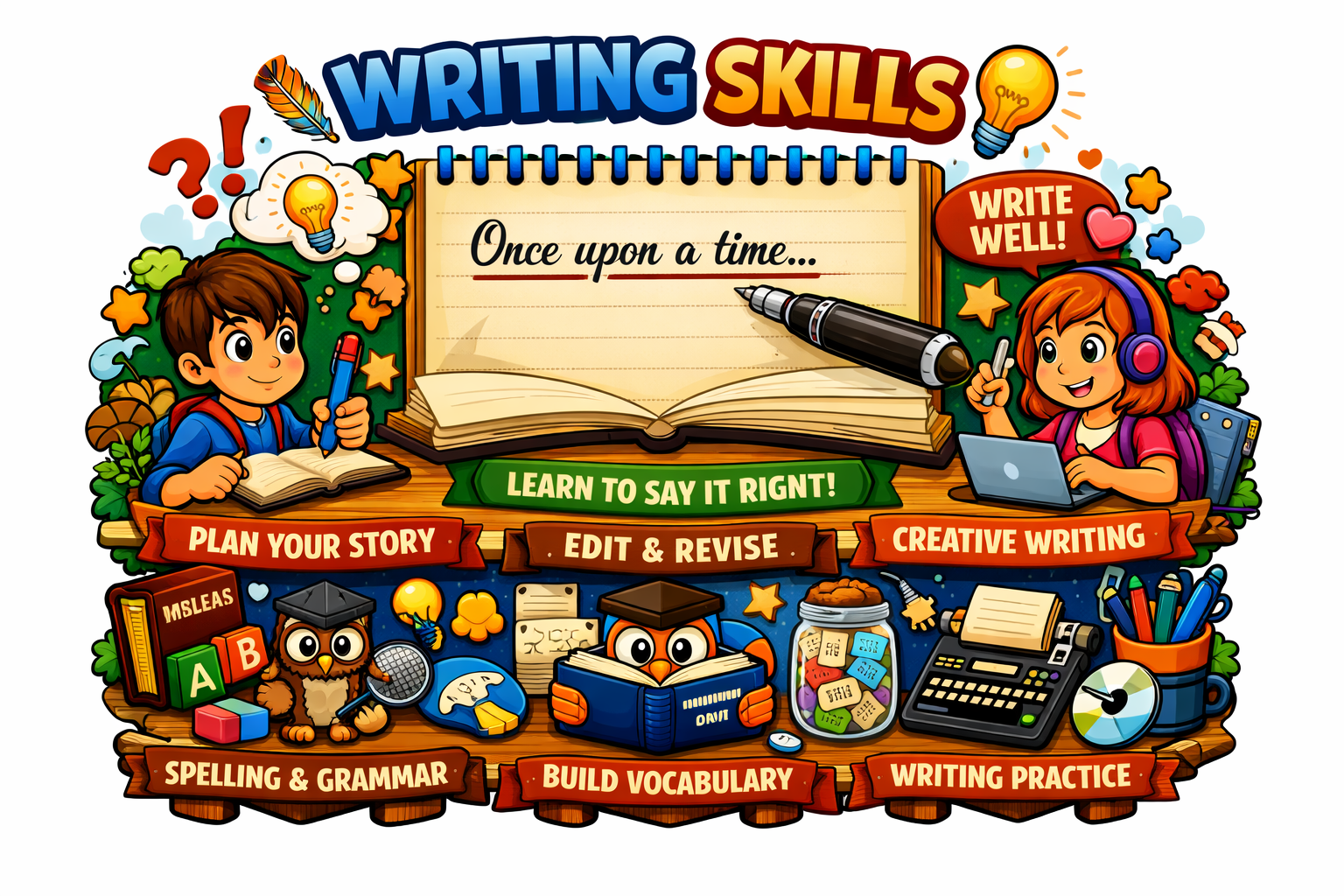
Mini Writing Skills Strategy Bank
Tip: Good writing is usually the result of planning, drafting, revising, and editing.
Common Writing Tasks in Exams
| Task | What to Include | Tone | Useful Tip |
|---|---|---|---|
| Paragraph Writing | One main idea, examples, concluding sentence | Clear and focused | Do not include too many unrelated points. |
| Essay Writing | Introduction, arguments/details, conclusion | Formal or semi-formal | Use separate paragraphs for separate ideas. |
| Formal Letter | Address, date, subject, salutation, body, closing | Polite and formal | State the purpose clearly in the first paragraph. |
| Email Writing | Subject, greeting, message, closing | Professional or friendly | Keep the subject line short and specific. |
| Notice Writing | Event, date, time, venue, instructions | Brief and formal | Include all essential details clearly. |
| Report Writing | Event details, facts, observations, conclusion | Objective and factual | Do not add unnecessary personal opinions. |
Note: Marks are often given for format, content, organisation, grammar, vocabulary, and relevance.
Practice
A) Multiple Choice: Choose the Best Answer
-
What is the first step in good writing?
Copying Planning Ignoring grammar Writing without thinking
-
A paragraph should usually focus on:
many unrelated ideas one main idea only difficult words random sentences
-
Which tone is best for a formal letter?
careless rude polite and formal joking only
-
What should a notice clearly mention?
only jokes event details unrelated stories personal secrets
-
What should you do after writing a draft?
submit immediately revise and edit delete everything add unrelated words
B) Writing Practice Tasks
- Write a paragraph on The Importance of Reading. (Use one topic sentence, three supporting points, and one concluding sentence.)
- Write a short formal email to your teacher requesting two days of leave. (Use subject, greeting, reason, request, and closing.)
- Write a notice for a school cleanliness drive. (Mention date, time, venue, and instructions.)
- Write five sentences about How to Save Water. (Use clear and simple sentences.)
- Improve a rough paragraph by checking spelling, punctuation, and grammar. (Editing is an important part of writing.)
C) Match the Writing Task with the Correct Format
| Writing Task | Correct Format Elements |
|---|---|
| Formal Email | Subject, greeting, message, closing |
| Notice | Title, date, event details, venue, instructions |
| Essay | Introduction, body paragraphs, conclusion |
| Report | Title, factual details, sequence, conclusion |
| Paragraph | Topic sentence, supporting details, concluding sentence |
Short Reading
Writing is a process. First, we plan our ideas. Then we write a draft. After that, we revise the content and edit grammar, spelling, and punctuation. A well-written answer is relevant, organised, clear, and complete.
Task: Write a short paragraph and then improve it by checking structure, grammar, and vocabulary.
Show Suggested Answers
Multiple Choice
- Planning
- One main idea
- Polite and formal
- Event details
- Revise and edit
Sample Paragraph: The Importance of Reading
Reading is one of the most useful habits for students. It improves vocabulary, increases knowledge, and develops imagination. Reading also helps students understand different people, places, and ideas. A student who reads regularly becomes more confident in speaking and writing. Therefore, everyone should develop the habit of reading every day.
Sample Formal Email
Subject: Request for Two Days Leave
Dear Sir/Madam,
I respectfully request leave for two days as I am not feeling well. I will complete the missed
classwork after I return. Kindly grant me leave for the requested period.
Thank you.
Yours sincerely,
Student Name
Format Matching
- Formal Email → Subject, greeting, message, closing
- Notice → Title, date, event details, venue, instructions
- Essay → Introduction, body paragraphs, conclusion
- Report → Title, factual details, sequence, conclusion
- Paragraph → Topic sentence, supporting details, concluding sentence
Clue Explanation
A strong answer follows the required format and stays focused on the topic. Planning improves structure, while revision improves grammar and clarity.
Exam tips
- Read the writing task carefully before starting.
- Follow the correct format for the task.
- Keep sentences clear and grammatically correct.
- Use paragraphs to separate ideas.
- Save time to revise spelling, punctuation, and grammar.