Poem Based Comprehension
Practice MCQsNone
Poem Based Comprehension tests your ability to understand a poem, identify its theme, speaker, tone, imagery, poetic devices, and answer questions based on the lines given.
What is Poem Based Comprehension?
In poem based comprehension, a short poem or stanza is given, followed by questions. You must understand not only the direct meaning of the lines but also the feelings, images, and implied ideas.
Unlike prose, a poem often uses rhythm, rhyme, imagery, symbols, and figures of speech. So, the reader must pay attention to both meaning and expression.
| Poetry Element | What it Means | Example Question |
|---|---|---|
| Theme | The main idea or message of the poem. | What is the central idea of the poem? |
| Speaker | The voice or person speaking in the poem. | Who is speaking in the poem? |
| Tone | The feeling or attitude expressed by the poet. | What is the tone of the poem? |
| Imagery | Words that create pictures in the reader’s mind. | Which line creates a visual image? |
| Rhyme | Similar ending sounds in lines. | Which two words rhyme in the stanza? |
“A poem is understood through meaning, feeling, sound, and image.”
Key points
- Read the poem slowly more than once.
- Identify the speaker and situation.
- Find the theme or message.
- Notice images, symbols, and repeated words.
- Answer using evidence from the poem.
Common Clues in Poem Based Comprehension
Poem based questions usually test your understanding of meaning, mood, poetic language, and expression.
Theme and Message
The main lesson or idea of the poem.
- nature and beauty
- hope and courage
- friendship and kindness
- time and change
Tone and Mood
The feeling created by the poem.
- happy / joyful
- sad / lonely
- peaceful / calm
- hopeful / inspiring
Poetic Devices
Special techniques used by poets.
- simile: like/as
- metaphor: direct comparison
- personification: human qualities
- alliteration: repeated sounds
Sound and Rhyme
The music of the poem.
- rhyming words
- repeated lines
- rhythm and beat
- sound effects
Mini Poem Comprehension Strategy Bank
Tip: Read the poem aloud softly if possible. The rhythm and sound often help reveal the mood.
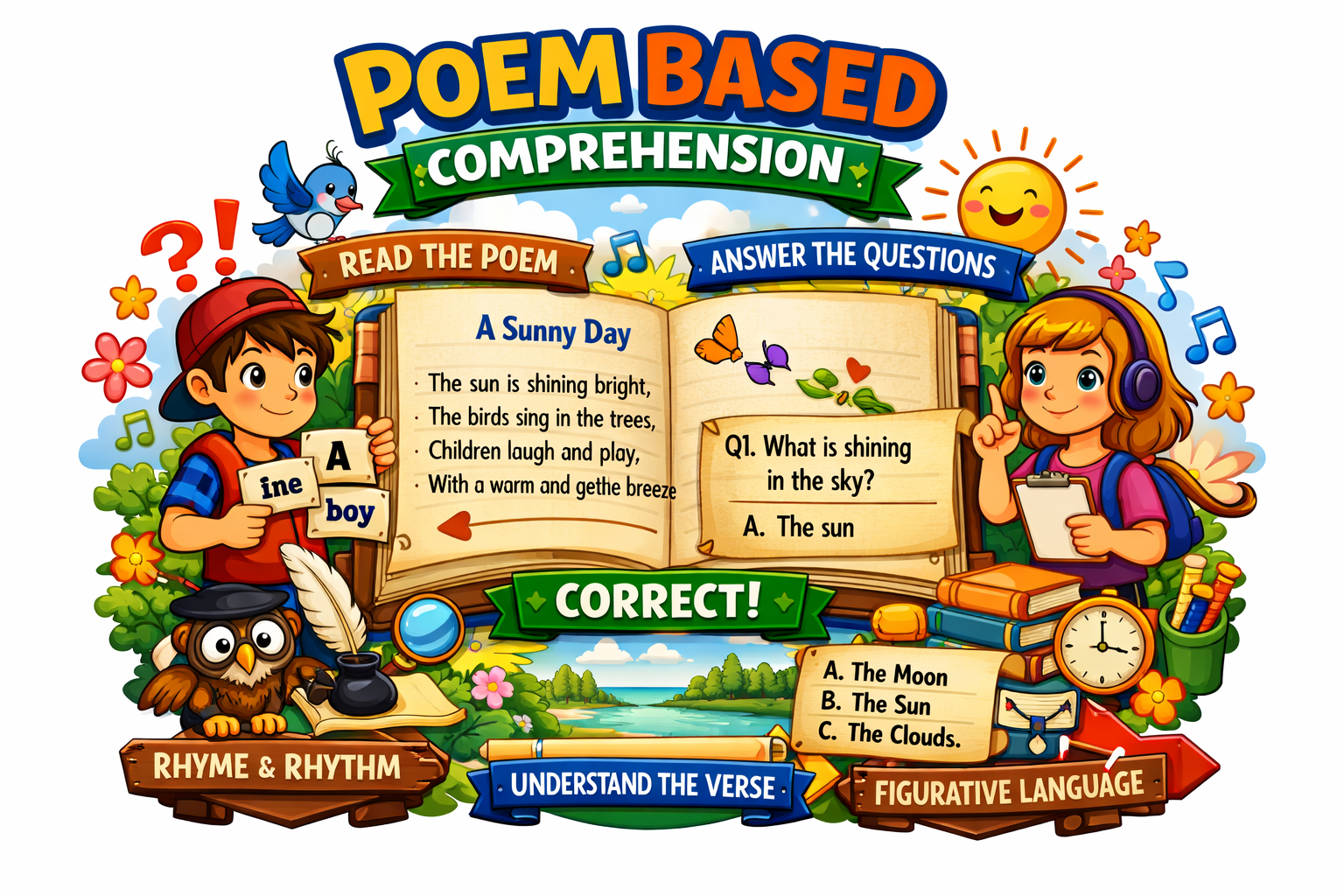
How to Approach a Poem
| Step | Action | Purpose |
|---|---|---|
| 1 | Read the poem once without stopping. | To understand the overall feeling. |
| 2 | Read again and mark difficult words. | To understand line-by-line meaning. |
| 3 | Identify speaker, setting, and subject. | To know who or what the poem is about. |
| 4 | Notice rhyme, repetition, and imagery. | To understand poetic effect. |
| 5 | Answer questions using poem evidence. | To avoid unsupported answers. |
Note: Poem questions may ask for direct meaning, central idea, poetic device, rhyme, tone, or meaning of a word from the poem.
Practice
A) Read the Poem
The Little Seed
A little seed slept under the ground,
Safe and silent, without a sound.
The rain came down, the sun shone bright,
The seed woke up to warmth and light.
It pushed through soil, so soft and deep,
No longer hidden, no more asleep.
A tiny plant began to grow,
Dancing gently to winds that blow.
Read the poem carefully and answer the questions below.
B) Multiple Choice Questions
-
What is the poem mainly about?
A bird learning to fly A seed growing into a plant A child playing in rain A river flowing through fields
-
Where was the little seed sleeping?
Under the ground On a tree In the sky Inside a house
-
Which two things helped the seed wake up?
Moon and stars Rain and sun Wind and snow Cloud and dust
-
The words ground and sound are examples of:
rhyme simile metaphor contrast
-
The line “Dancing gently to winds that blow” gives the plant:
human-like action a sad feeling a sharp sound a heavy weight
C) Short Answer Questions
- What does the phrase “safe and silent” tell us about the seed?
- What changes after the rain and sunlight reach the seed?
- Find two pairs of rhyming words from the poem.
- What is the mood of the poem?
- Give a suitable title other than The Little Seed.
D) Identify the Poetic Device
| Line / Words | Device / Feature |
|---|---|
| ground / sound | Rhyme |
| bright / light | Rhyme |
| Safe and silent | Alliteration-like repeated initial sound |
| The seed woke up | Personification |
| Dancing gently | Personification / imagery |
Poetry Reading Reminder
A poem often says a simple idea in a beautiful way. To understand it, read the lines slowly, notice the images, and think about the feeling created by the words. The best answer is the one supported by the poem’s words and mood.
Task: Explain the central idea of the poem in one sentence.
Show Suggested Answers
Multiple Choice Questions
- A seed growing into a plant.
- Under the ground.
- Rain and sun.
- Rhyme.
- Human-like action.
Short Answer Questions
- It tells us that the seed was quietly resting under the ground, protected and undisturbed.
- The seed begins to wake up, push through the soil, and grow into a tiny plant.
- Rhyming pairs include ground/sound, bright/light, deep/asleep, and grow/blow.
- The mood is peaceful, hopeful, and cheerful.
- Suggested titles: A Seed Begins to Grow / From Seed to Plant.
Central Idea
The poem describes how a small seed, with the help of rain and sunlight, wakes up and grows into a plant.
Exam tips
- Read the poem at least twice.
- Identify the speaker, subject, and mood.
- Use context to understand difficult words.
- Look for rhyme, repetition, imagery, and personification.
- Support answers with words or ideas from the poem.