Spotting errors
Practice MCQsNone
Spotting Errors questions test your ability to identify grammatical, structural, and usage mistakes in a sentence. These questions are common in school exams, competitive exams, and English proficiency tests.
What is Spotting Errors?
In Spotting Errors, a sentence is divided into parts. One part may contain an error, or the sentence may be completely correct. Your task is to identify the part that contains the error.
Errors may be related to subject-verb agreement, tense, articles, prepositions, pronouns, modifiers, word usage, or sentence structure.
| Incorrect Sentence | Error | Correct Sentence |
|---|---|---|
| Each of the boys have a book. | Subject-verb agreement | Each of the boys has a book. |
| She is good in mathematics. | Incorrect preposition | She is good at mathematics. |
| I have seen him yesterday. | Tense error | I saw him yesterday. |
| He discussed about the problem. | Unnecessary preposition | He discussed the problem. |
“To spot an error, first understand what the sentence is trying to say.”
Key points
- Read the full sentence before checking parts.
- Identify the subject and verb.
- Check tense and time clues.
- Look for fixed prepositions and collocations.
- Remember that “No error” may also be correct.
Common Areas Tested in Spotting Errors
Most error-spotting questions are based on repeated grammar patterns. Learning these areas improves accuracy.
Subject-Verb Agreement
The verb must agree with the subject.
- He goes to school.
- They go to school.
- Each student has a book.
Tense Errors
The tense should match the time expression.
- Yesterday, I went.
- Now, she is studying.
- Since 2020, he has lived here.
Preposition Errors
Some words take fixed prepositions.
- interested in
- good at
- senior to
- different from
Articles and Determiners
Use a, an, the, some, many, much correctly.
- an honest man
- a university
- much water
- many books
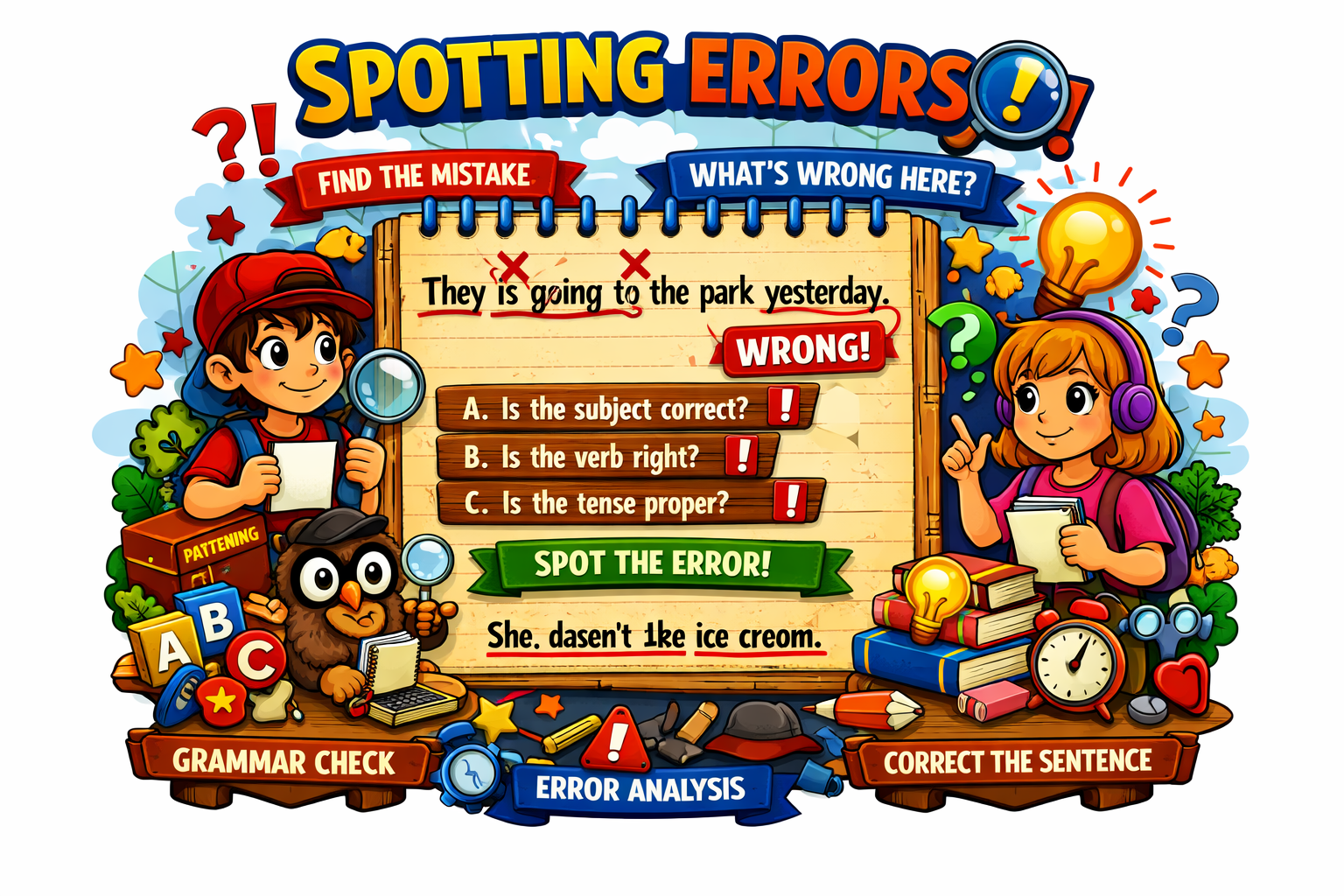
Mini Spotting Errors Strategy Bank
Tip: In exams, check one grammar area at a time: verb, tense, pronoun, preposition, article, and word usage.
Common Exam Examples
| Sentence with Error | Error Part | Correction | Rule |
|---|---|---|---|
| Neither of the answers are correct. | are | is | Neither is singular. |
| He is married with a doctor. | with | to | Correct phrase: married to. |
| The news are shocking. | are | is | News is treated as singular. |
| She is more taller than her sister. | more taller | taller | Avoid double comparative. |
| He returned back from Delhi. | returned back | returned | Returned already means came back. |
| I prefer tea than coffee. | than | to | Correct structure: prefer A to B. |
| One of my friends are a doctor. | are | is | One of + plural noun takes singular verb. |
| She is suffering from fever. | from | with | Common usage: suffering from a disease, but suffering with fever is also widely used. Prefer exam pattern carefully. |
Note: Some usage questions may depend on accepted exam conventions. Always prefer the option that is most standard and natural.
Practice
A) Multiple Choice: Identify the Error Part
-
A) Each of the students / B) have submitted / C) the assignment / D) No errorA B C D
-
A) She is / B) good in / C) mathematics / D) No errorA B C D
-
A) I saw / B) him / C) yesterday / D) No errorA B C D
-
A) He discussed / B) about the problem / C) with his teacher / D) No errorA B C D
-
A) The news / B) are shocking / C) to everyone / D) No errorA B C D
B) Correct the Errors
- He does not knows the answer. (Hint: after does not, use base verb)
- She is senior than me. (Hint: senior takes “to”)
- I have completed the work yesterday. (Hint: yesterday needs simple past)
- The teacher asked me to repeat again. (Hint: avoid redundancy)
- One of my friend is a doctor. (Hint: one of + plural noun)
C) Match the Error with the Error Type
| Sentence | Error Type |
|---|---|
| He go to school daily. | Subject-verb agreement |
| She is interested on music. | Preposition error |
| I am seeing him yesterday. | Tense error |
| He bought a umbrella. | Article error |
| Please return back my book. | Redundancy |
Short Reading
Spotting errors requires patience and careful reading. A sentence may look correct at first, but a small mistake in verb form, tense, preposition, article, or word usage can change the answer. Good grammar habits make error detection faster and more accurate.
Task: Take five sentences from your own writing and check them for subject-verb agreement, tense, preposition, article, and redundancy errors.
Show Suggested Answers
Multiple Choice
- B — have submitted → has submitted
- B — good in → good at
- D — No error
- B — discussed about the problem → discussed the problem
- B — are shocking → is shocking
Correct the Errors
- He does not know the answer.
- She is senior to me.
- I completed the work yesterday.
- The teacher asked me to repeat.
- One of my friends is a doctor.
Error Type: Corrected Sentences
- He go to school daily. → He goes to school daily.
- She is interested on music. → She is interested in music.
- I am seeing him yesterday. → I saw him yesterday.
- He bought a umbrella. → He bought an umbrella.
- Please return back my book. → Please return my book.
Clue Explanation
Common error clues include singular subjects with plural verbs, wrong prepositions, incorrect tense with time expressions, wrong articles before vowel sounds, and repeated meanings such as return back.
Exam tips
- Do not answer before reading the full sentence.
- Check subject-verb agreement first.
- Use time words to identify tense errors.
- Watch fixed phrases such as good at, senior to, and interested in.
- Select “No error” only when every part is correct.