Comprehension
Practice MCQsComprehension is the understanding and interpretation of what is read. To be able to accurately understand written material, students need to be able to (1) decode what they read; (2) make connections between what they read and what they already know; and (3) think deeply about what they have read.
Comprehension tests your ability to read a passage carefully, understand its meaning, identify facts, infer ideas, and answer questions based on the given text.
What is Comprehension?
Comprehension means understanding a written passage. In exams, a passage is given, followed by questions that test your understanding of its content, meaning, tone, vocabulary, and implied ideas.
A good reader does not merely read the words. A good reader identifies the main idea, understands supporting details, notices keywords, and connects ideas logically.
| Skill | What it Means | Example Question |
|---|---|---|
| Main Idea | Understanding what the passage is mainly about. | What is the central theme of the passage? |
| Factual Detail | Finding information directly stated in the passage. | According to the passage, what did the farmer do? |
| Inference | Understanding an idea that is suggested but not directly stated. | What can be inferred from the author’s statement? |
| Vocabulary in Context | Finding the meaning of a word as used in the passage. | What does the word “remarkable” mean in the passage? |
“In comprehension, every answer must be supported by the passage.”
Key points
- Read the passage carefully.
- Identify the main idea first.
- Underline or remember keywords.
- Answer only from the passage.
- Check the tone and purpose of the writer.
Common Types of Comprehension Questions
Comprehension questions may test direct understanding, hidden meaning, vocabulary, tone, or the structure of the passage.
Direct Questions
Answers are clearly stated in the passage.
- Who did the action?
- Where did it happen?
- What was the result?
Inference Questions
Answers are suggested, not directly stated.
- What can we infer?
- What does the writer imply?
- What is likely to happen next?
Vocabulary Questions
Meaning of words based on passage context.
- Find the synonym.
- Find the antonym.
- Choose the contextual meaning.
Tone and Purpose
Questions about writer’s attitude or aim.
- Is the tone serious?
- Is the writer informing?
- Is the passage persuasive?
Mini Comprehension Strategy Bank
Tip: Do not panic if the passage is long. Read the questions first only when time is limited; otherwise, read the passage once to understand the flow.
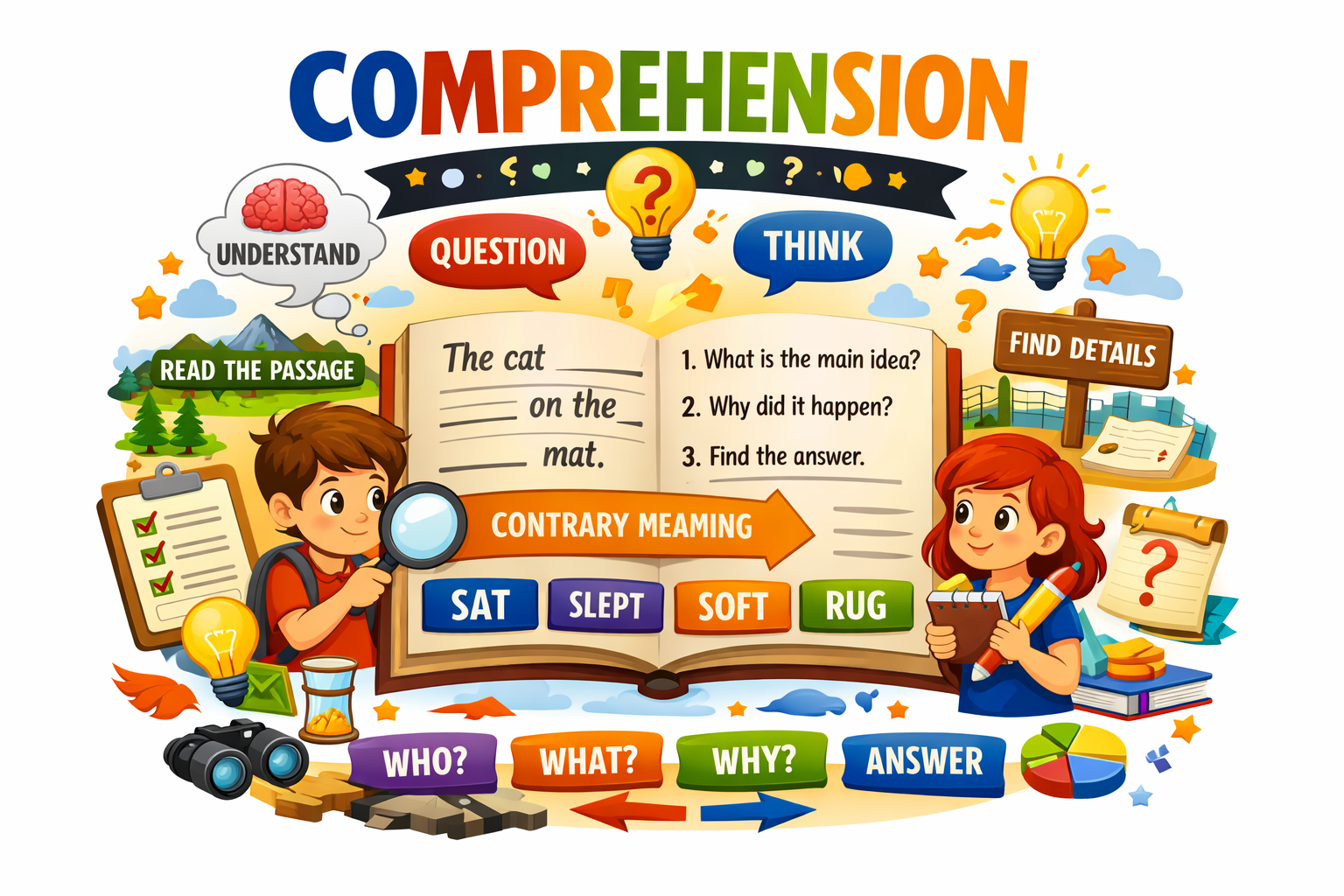
How to Approach a Comprehension Passage
| Step | Action | Purpose |
|---|---|---|
| 1 | Read the title or first sentence carefully. | To understand the topic. |
| 2 | Read the whole passage once without stopping. | To understand the general meaning. |
| 3 | Identify the main idea and supporting details. | To answer theme and summary questions. |
| 4 | Return to the passage for direct questions. | To avoid guessing. |
| 5 | Use context for vocabulary questions. | To find the correct meaning in the passage. |
| 6 | Eliminate unsupported options. | To improve accuracy. |
Note: In comprehension, avoid extreme options such as “always”, “never”, or “completely” unless the passage clearly supports them.
Practice
A) Read the Passage
Trees are among the most valuable gifts of nature. They provide oxygen, give shade, reduce pollution, and support many forms of life. Birds build nests on trees, animals find shelter under them, and humans use their fruits, wood, leaves, and medicines. In cities, trees help reduce heat and make the environment more pleasant.
However, rapid urban growth has led to the cutting of many trees. This has increased pollution and disturbed the balance of nature. Planting trees is not only an environmental duty but also a responsibility towards future generations. If every person plants and protects even one tree, the world can become healthier and greener.
Read the passage carefully and answer the questions below.
B) Multiple Choice Questions
-
What is the main idea of the passage?
Trees are useful only for wood Trees are valuable and must be protected Cities do not need trees Birds are more important than trees
-
According to the passage, trees help cities by:
increasing heat reducing heat blocking all roads stopping rain
-
What has disturbed the balance of nature?
Planting more trees Protecting forests Cutting many trees Building bird nests
-
The word valuable in the passage means:
useless precious ordinary weak
C) Short Answer Questions
- Mention any two benefits of trees given in the passage.
- How do trees support birds and animals?
- Why is planting trees called a responsibility towards future generations?
- Find one word from the passage that means home or protection.
- Give a suitable title for the passage.
D) Identify the Question Type
| Question | Question Type |
|---|---|
| What is the passage mainly about? | Main idea |
| What does the word “valuable” mean? | Vocabulary in context |
| What can happen if everyone plants and protects one tree? | Inference / result |
| According to the passage, who uses trees for shelter? | Direct factual detail |
Reading Reminder
A comprehension passage is not a memory test; it is an understanding test. Read patiently, find evidence in the passage, and choose the answer that is most strongly supported.
Task: Try explaining the main idea of the passage in one sentence.
Show Suggested Answers
Multiple Choice Questions
- Trees are valuable and must be protected.
- Reducing heat.
- Cutting many trees.
- Precious.
Short Answer Questions
- Trees provide oxygen, give shade, reduce pollution, support life, provide fruits, wood, leaves, and medicines.
- Birds build nests on trees, and animals find shelter under them.
- Because trees help keep the world healthier and greener for people who will live in the future.
- Shelter.
- Suggested title: The Importance of Trees / Protect Trees, Protect Life.
Main Idea in One Sentence
Trees are essential for life and the environment, so people must plant and protect them.
Exam tips
- Read the passage before answering.
- For factual questions, locate the exact line.
- For vocabulary, use surrounding words as clues.
- For inference, avoid unsupported assumptions.
- For title questions, choose the option covering the whole passage.