One Word Substitution
Practice MCQsNone
One Word Substitution means replacing a long phrase or description with a single precise word. It improves vocabulary, clarity, and exam performance.
What is One Word Substitution?
One Word Substitution is the use of one exact word in place of a group of words. Instead of writing a long explanation, we use a single word that carries the same meaning.
For example, instead of saying “a person who cannot read or write”, we can use the word illiterate. Instead of saying “a person who loves books”, we can say bibliophile.
| Phrase / Description | One Word | Example Sentence |
|---|---|---|
| A person who cannot read or write | Illiterate | The programme helps illiterate adults learn basic reading. |
| A person who loves books | Bibliophile | She is a bibliophile with a large personal library. |
| A person who studies plants | Botanist | The botanist studied rare medicinal plants. |
| A speech made without preparation | Extempore | He gave an extempore speech at the function. |
“A good one-word substitute is short, exact, and meaningful.”
Key points
- Replace a phrase with one exact word.
- Check the meaning carefully.
- Identify whether the word refers to a person, place, action, habit, or field.
- Many exam questions test common categories.
- Learn words with example sentences.
Common Categories of One Word Substitution
One Word Substitution questions usually come from repeated categories such as people, places, professions, habits, sciences, speech, and government.
People and Character
Words that describe people or their qualities.
- one who loves mankind → philanthropist
- one who hates mankind → misanthrope
- one who speaks many languages → polyglot
Professions and Fields
Words related to study or occupation.
- one who studies plants → botanist
- one who studies animals → zoologist
- one who studies stars → astronomer
Speech and Writing
Words related to language, speech, and writing.
- a speech without preparation → extempore
- a written life story of a person → biography
- one’s own life story → autobiography
Places and Institutions
Words that describe special places.
- place for keeping books → library
- place for sick people → hospital
- place for keeping animals → zoo
Mini One Word Substitution Bank
food lover → gourmet
one who cannot read/write → illiterate
study of animals → zoology
study of stars → astronomy
life story by oneself → autobiography
list of books → catalogue
able to be heard → audible
able to be read → legible
Tip: Group words by category. This makes revision easier than memorising random words.
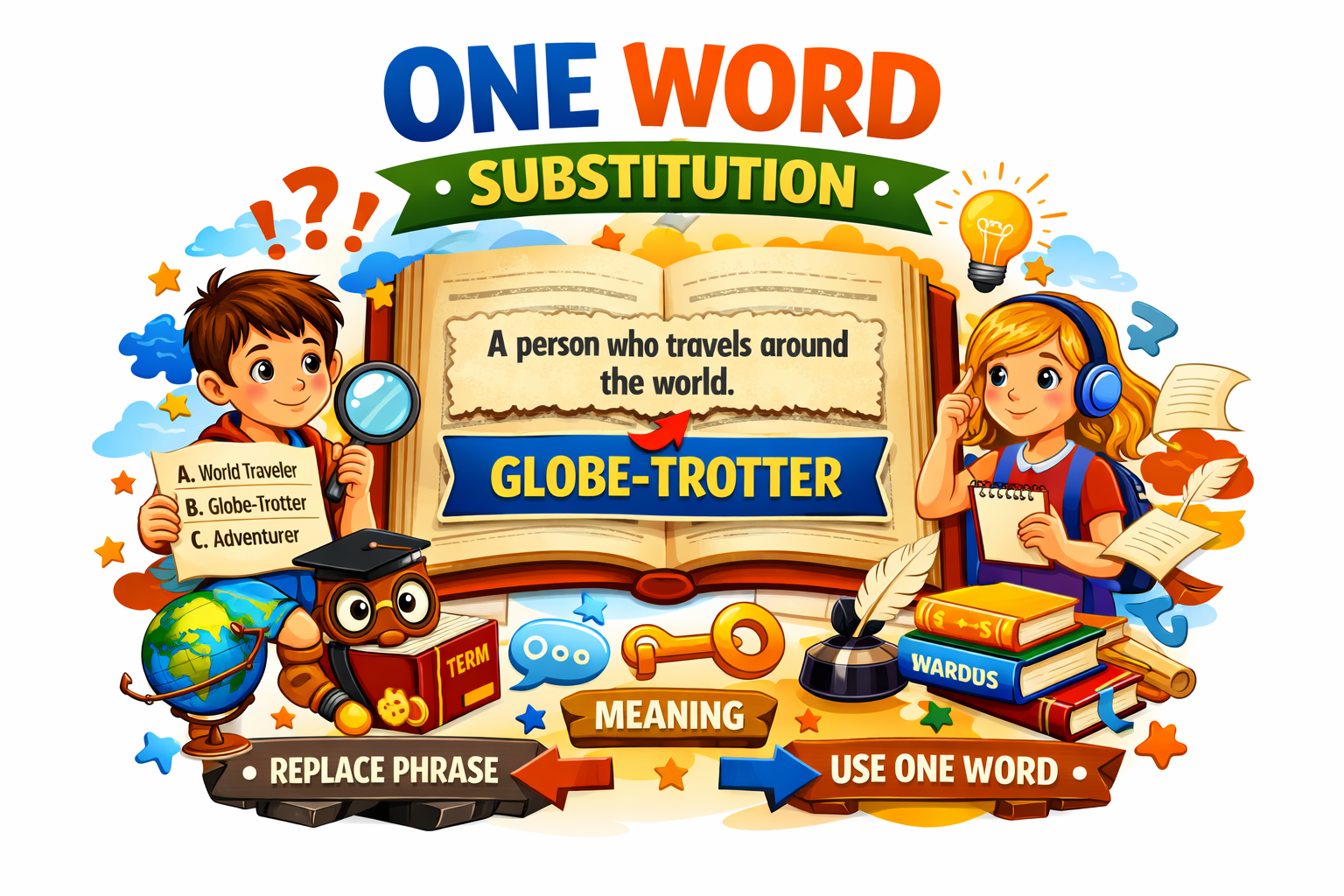
Common One Word Substitutions for Exams
| Phrase / Description | One Word | Category | Example Sentence |
|---|---|---|---|
| A person who loves books | Bibliophile | Person | The bibliophile spent hours in the library. |
| A person who looks at the bright side of life | Optimist | Personality | An optimist sees hope even in difficulty. |
| A person who looks at the dark side of life | Pessimist | Personality | A pessimist expects problems in every situation. |
| A person who speaks many languages | Polyglot | Language | The tourist guide was a polyglot. |
| A person who studies rocks | Geologist | Profession | The geologist examined the mountain rocks. |
| A person who treats diseases of the teeth | Dentist | Profession | The dentist advised regular brushing. |
| A place where birds are kept | Aviary | Place | The zoo has a beautiful aviary. |
| A place where dead bodies are kept | Mortuary | Place | The body was taken to the mortuary. |
| That which cannot be read | Illegible | Quality | His handwriting was illegible. |
| That which cannot be heard | Inaudible | Quality | The speaker’s voice was inaudible. |
Note: In exams, options may be close in meaning. Choose the word that exactly matches the full phrase.
Practice
A) Multiple Choice: Choose the Correct One Word
-
A person who loves books:
botanist bibliophile geologist dentist
-
A person who speaks many languages:
polyglot optimist pessimist novelist
-
That which cannot be read:
audible legible illegible visible
-
A person who studies plants:
botanist zoologist astronomer geologist
-
A speech made without preparation:
biography dialogue extempore monologue
B) Fill in the Blanks with One Word
- A person who looks at the bright side of life is called an ________. (Hint: positive thinker)
- A person who looks at the dark side of life is called a ________. (Hint: negative thinker)
- A place where birds are kept is called an ________. (Hint: bird enclosure)
- A person who studies rocks is called a ________. (Hint: study of earth/rocks)
- Something that cannot be heard is called ________. (Hint: opposite of audible)
C) Match the Phrase with the One Word
| Phrase / Description | Options |
|---|---|
| A person who treats teeth | dentist / botanist / pilot / author |
| A person who writes novels | poet / novelist / painter / singer |
| Life story written by oneself | biography / autobiography / history / diary |
| That which cannot be corrected | audible / legible / incorrigible / visible |
| A place where books are kept | library / laboratory / hospital / museum |
Short Reading
A bibliophile visited the city library and met a polyglot who could speak several languages. Later, they attended an extempore speech competition where a young optimist spoke confidently about the future.
Task: Identify the phrase or description represented by each bold word.
Show Suggested Answers
MCQ
- bibliophile
- polyglot
- illegible
- botanist
- extempore
Fill in the Blanks
- optimist
- pessimist
- aviary
- geologist
- inaudible
Matching
- A person who treats teeth → dentist
- A person who writes novels → novelist
- Life story written by oneself → autobiography
- That which cannot be corrected → incorrigible
- A place where books are kept → library
Reading Meaning
bibliophile → a person who loves books
polyglot → a person who speaks many languages
extempore → speech made without preparation
optimist → a person who looks at the bright side of life
Exam tips
- Read the full phrase carefully before choosing the word.
- Check whether the answer refers to a person, place, thing, quality, or action.
- Do not confuse similar words like biography and autobiography.
- Learn one-word substitutions in categories.
- Use example sentences to remember difficult words.