Ordering of Sentences
Practice MCQsNone
Ordering of Sentences questions test your ability to arrange jumbled sentences into a meaningful and logically connected paragraph.
What is Ordering of Sentences?
In Ordering of Sentences, a group of sentences is given in a mixed order. You must arrange them correctly so that they form a clear and meaningful paragraph.
The correct order depends on the main idea, logical sequence, connectors, pronouns, and flow of information.
| Clue | What to Look For | Example |
|---|---|---|
| Opening Sentence | Introduces the topic clearly. | “Trees are important for life.” |
| Pronoun Clue | Pronouns refer to nouns mentioned earlier. | “They provide oxygen.” Here, they may refer to trees. |
| Connector Clue | Words like however, therefore, also, because show relation. | “Therefore” usually comes after a reason. |
| Conclusion | Ends the paragraph naturally. | “Thus, we must protect trees.” |
“A well-ordered paragraph moves from idea to idea without confusion.”
Key points
- Find the sentence that introduces the topic.
- Connect pronouns with their nouns.
- Use connectors to understand logic.
- Follow time, cause-effect, or general-to-specific order.
- Read the final paragraph to check flow.
Common Clues for Ordering Sentences
Sentence ordering questions usually follow logical patterns. Recognising these patterns helps you arrange sentences quickly.
Topic Introduction
The first sentence usually introduces the main subject.
- It does not depend on earlier information.
- It gives a broad idea.
- It often contains the main noun.
Pronoun Reference
Pronouns usually come after the noun they refer to.
- he / she → person mentioned earlier
- it → singular object or idea
- they / them → plural noun
Time Sequence
Events may follow a chronological order.
- first → next → then → finally
- morning → afternoon → evening
- past → present → future
Cause and Result
A reason usually comes before its result.
- because → reason
- therefore → result
- as a result → conclusion
Mini Sentence Ordering Strategy Bank
Tip: After arranging, read the paragraph aloud mentally. If the flow feels broken, check pronouns and connectors again.
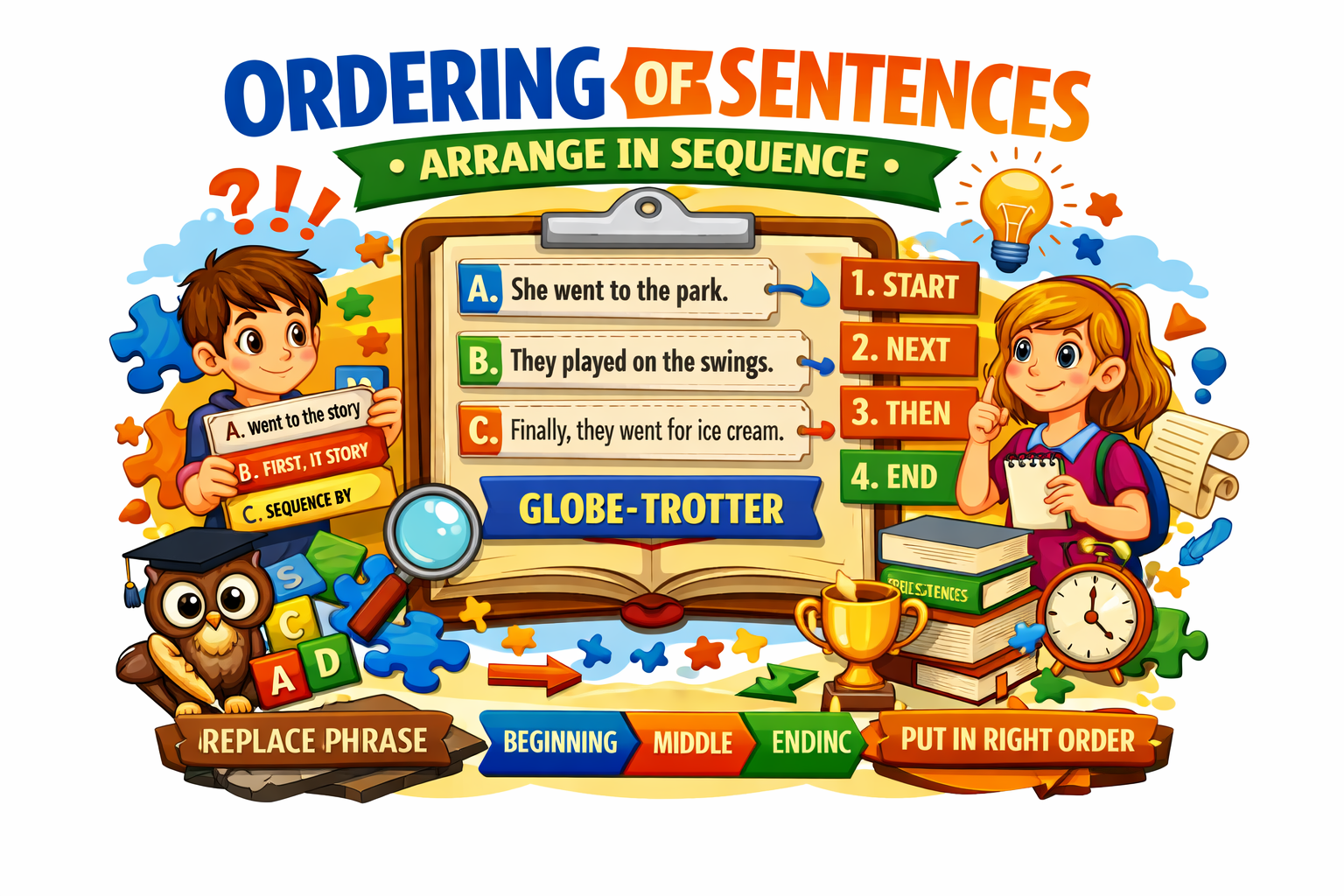
Common Exam Patterns
| Pattern | Order | Example Flow | Why? |
|---|---|---|---|
| General to Specific | Main idea → Details → Example | Reading is useful → It improves vocabulary → For example, students learn new words. | The paragraph moves from broad idea to example. |
| Cause and Effect | Reason → Result → Conclusion | It rained heavily → Roads were flooded → Schools remained closed. | The cause comes before the effect. |
| Problem and Solution | Problem → Impact → Solution | Plastic causes pollution → It harms animals → We should reduce plastic use. | The solution follows the problem. |
| Chronological Order | First → Next → Then → Finally | He woke up → He got ready → He reached school → He attended class. | Events are arranged by time. |
Note: In exams, options may contain sentences that all relate to the topic, but only one order gives a smooth paragraph.
Practice
A) Multiple Choice: Choose the Correct Order
-
Arrange the sentences in the correct order:
P. Therefore, students should develop the habit of reading.
Q. Reading improves vocabulary and imagination.
R. It also helps students understand different ideas.
S. Reading is one of the best habits for learning.S-Q-R-P Q-S-P-R P-R-S-Q R-Q-S-P -
Arrange the sentences in the correct order:
P. As a result, many roads were flooded.
Q. It rained heavily throughout the night.
R. The authorities advised people to stay indoors.
S. The next morning, traffic moved very slowly.Q-P-S-R P-Q-R-S S-R-Q-P R-S-P-Q -
Arrange the sentences in the correct order:
P. Finally, the plant grows into a tree.
Q. First, a seed is planted in the soil.
R. Then, it gets water, air, and sunlight.
S. After some time, a small shoot comes out.Q-R-S-P P-S-R-Q R-Q-P-S S-P-Q-R -
Arrange the sentences in the correct order:
P. Hence, we must reduce the use of plastic.
Q. Plastic waste pollutes land and water.
R. It also harms animals and marine life.
S. Plastic pollution has become a serious problem.S-Q-R-P Q-P-S-R R-S-P-Q P-Q-R-S
B) Arrange the Sentences Manually
-
Arrange these sentences into a paragraph:
A. This saves time and reduces traffic.
B. Public transport is useful in crowded cities.
C. It allows many people to travel together.
D. Therefore, more people should use buses and trains. -
Arrange these sentences into a paragraph:
A. He practised every morning.
B. Rohan wanted to win the race.
C. His speed improved gradually.
D. Finally, he won the first prize. -
Arrange these sentences into a paragraph:
A. It gives us oxygen and shade.
B. A tree is very useful to humans and animals.
C. Birds build nests on it.
D. So, we should protect trees. -
Arrange these sentences into a paragraph:
A. As a result, he missed the school bus.
B. He woke up late in the morning.
C. He had to walk to school.
D. He got ready in a hurry.
C) Identify the Best Sentence Pair
| Sentence 1 | Best Follow-up Sentence |
|---|---|
| Trees reduce pollution. |
A) They also provide shade. B) The train arrived late. C) He likes sweets. D) The book is on the table. |
| She was ill. |
A) Therefore, she stayed at home. B) The sun rises in the east. C) The river is long. D) Birds fly in the sky. |
| The first question was easy. |
A) However, the second one was difficult. B) Rice grows in fields. C) The road was narrow. D) The school has a playground. |
| Water is precious. |
A) We should not waste it. B) The boy sings well. C) The market was crowded. D) A pen is used for writing. |
Short Reading
A paragraph is not just a group of sentences. It is a connected unit of thought. Each sentence should either introduce, explain, continue, contrast, or conclude an idea. Sentence ordering becomes easier when we identify the opening sentence, sentence pairs, connectors, and conclusion.
Task: Take any jumbled paragraph and mark the opening sentence, supporting details, and concluding sentence.
Show Suggested Answers
Multiple Choice
- S-Q-R-P
- Q-P-S-R
- Q-R-S-P
- S-Q-R-P
Arrange Manually
- B-C-A-D
- B-A-C-D
- B-A-C-D
- B-D-A-C
Best Sentence Pair
- Trees reduce pollution → A) They also provide shade.
- She was ill → A) Therefore, she stayed at home.
- The first question was easy → A) However, the second one was difficult.
- Water is precious → A) We should not waste it.
Clue Explanation
The opening sentence introduces the topic. Supporting sentences add details, examples, causes, or results. Words like therefore, however, as a result, and finally help decide the order.
Exam tips
- Find the sentence that can start independently.
- Do not start with a sentence beginning with unclear pronouns.
- Look for sentence pairs before arranging all sentences.
- Use connectors to identify cause, contrast, example, and result.
- Read the final order once to check paragraph flow.