Antonyms - One Word
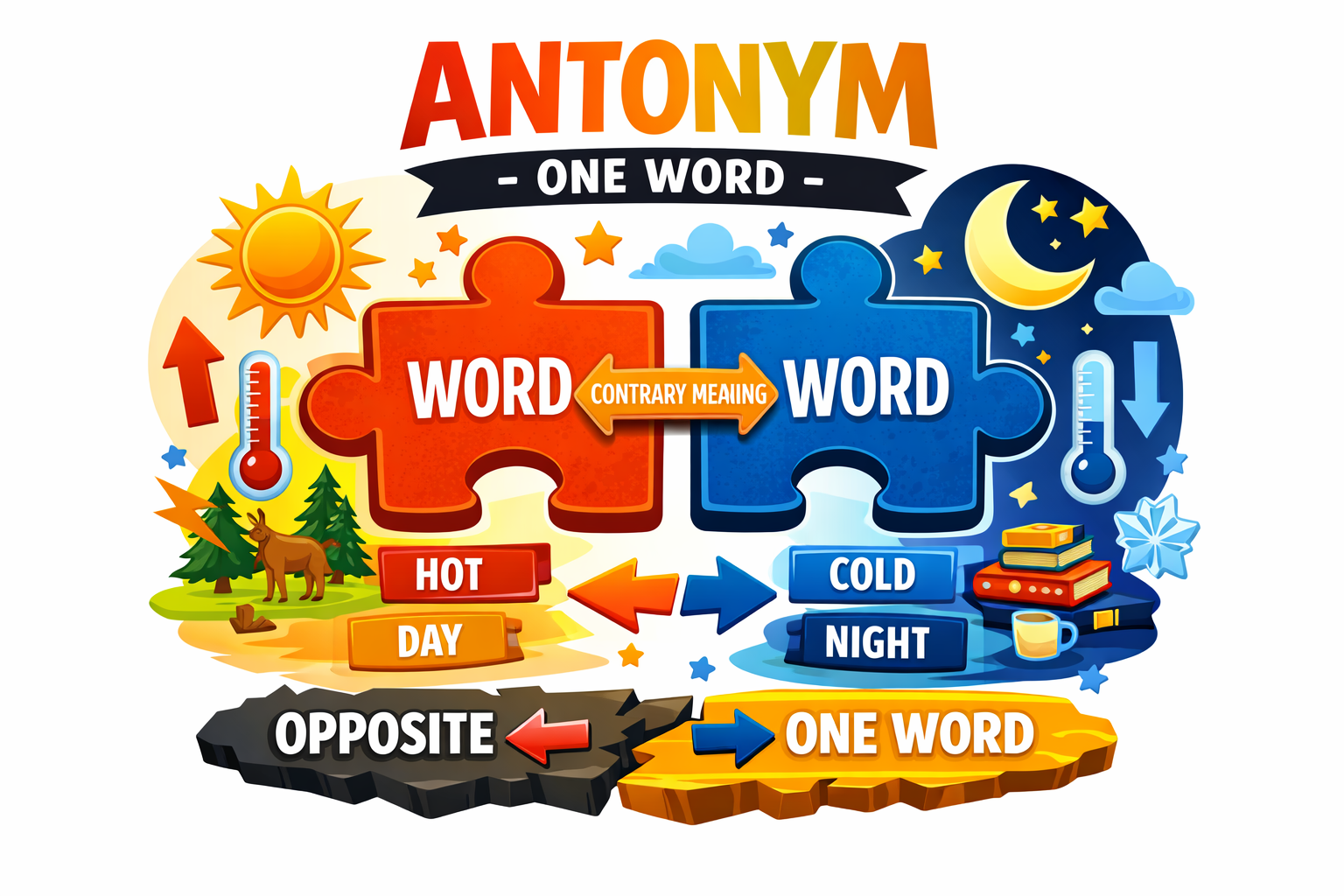
Practice MCQsA word that has the exact opposite meaning of another word is its antonym. A word that expresses a meaning opposed to the meaning of another word, in which case the two words are antonyms of each other
Understanding antonyms helps learners identify opposite meanings, improve vocabulary, and choose the correct word in sentence-based questions.
What are Antonyms?
Antonyms are words that have opposite or nearly opposite meanings. They help us understand contrast, comparison, and change in meaning.
For example, the antonym of hot is cold, the antonym of happy is sad, and the antonym of begin is end.
| Word | Antonym | Meaning Contrast |
|---|---|---|
| Happy | sad | feeling good ↔ feeling unhappy |
| Big | small | large in size ↔ little in size |
| Fast | slow | moving quickly ↔ moving with less speed |
| Begin | end | to start ↔ to finish |
“To find the antonym, first understand the exact meaning of the given word.”
Key points
- Antonyms are opposite meaning words.
- Some opposites are direct: hot ↔ cold.
- Some opposites depend on context.
- Prefixes can also create opposites.
- In exams, choose the closest opposite.
Types of Antonyms
Antonyms can be grouped according to the type of opposite meaning they show.
Direct Opposites
Words with clear opposite meanings.
- hot ↔ cold
- day ↔ night
- high ↔ low
Gradable Opposites
Opposites that can have degrees.
- big ↔ small
- rich ↔ poor
- young ↔ old
Relational Opposites
Words that show opposite roles or directions.
- buy ↔ sell
- give ↔ receive
- teacher ↔ student
Prefix-based Opposites
Opposites formed using prefixes.
- happy ↔ unhappy
- possible ↔ impossible
- agree ↔ disagree
Mini Antonym Bank
clean ↔ dirty
strong ↔ weak
accept ↔ reject
remember ↔ forget
brave ↔ afraid
calm ↔ worried
abundant ↔ scarce
expand ↔ contract
Tip: Learn antonyms in pairs. It improves both vocabulary and sentence understanding.
Common Exam Antonyms
| Word | Closest Antonym | Meaning | Example Sentence |
|---|---|---|---|
| Abundant | scarce | available in large quantity | Water was abundant after the rains. |
| Ancient | modern | very old | The museum displayed ancient coins. |
| Brave | cowardly | showing courage | The brave child spoke the truth. |
| Calm | agitated | peaceful and relaxed | She remained calm during the test. |
| Expand | contract | to become larger | Metals expand when heated. |
| Honest | dishonest | truthful and fair | He is an honest worker. |
| Increase | decrease | to become more | The price may increase next month. |
| Victory | defeat | success in a contest | The team celebrated its victory. |
Note: In competitive exams, the answer is usually the word that is most opposite in meaning in the given context.
Practice
A) Multiple Choice: Choose the Closest Antonym
-
Antonym of rapid:
quick slow fast swift
-
Antonym of ancient:
old past modern historic
-
Antonym of courageous:
brave bold fearful heroic
-
Antonym of accept:
receive approve reject allow
B) Fill in the Blanks with Suitable Antonyms
- The box is not heavy; it is very ________. (Use an antonym of heavy)
- Do not forget your homework; please ________ it. (Use an antonym of forget)
- The road is not wide; it is ________. (Use an antonym of wide)
- The answer is not wrong; it is ________. (Use an antonym of wrong)
C) Match the Words with Their Antonyms
| Word | Options |
|---|---|
| Begin | start / open / end / grow |
| Huge | large / tiny / broad / tall |
| Silent | quiet / peaceful / noisy / calm |
| Beautiful | pretty / lovely / ugly / graceful |
Short Reading
The brave boy helped a weak old man cross the wide road. It was a bright morning, and the street was very busy.
Task: Find suitable antonyms for the bold words in the paragraph.
Show Suggested Answers
MCQ
- slow
- modern
- fearful
- reject
Fill in the Blanks
- light
- remember
- narrow
- right / correct
Matching
- Begin → end
- Huge → tiny
- Silent → noisy
- Beautiful → ugly
Reading Antonyms
brave → cowardly / fearful
weak → strong
wide → narrow
bright → dull / dark
busy → quiet / free
Exam tips
- First understand the meaning of the given word.
- Then look for the most opposite meaning.
- Check whether the word is used as a noun, verb, or adjective.
- Do not confuse synonyms with antonyms.
- Learn common prefix-based opposites: un-, in-, im-, dis-, non-.