Data Sufficiency
Practice MCQsNone
Data Sufficiency is an important reasoning ability topic where a question is followed by two or more statements. Your task is not always to calculate the final answer, but to decide whether the given statements provide enough information to answer the question.
What is Data Sufficiency?
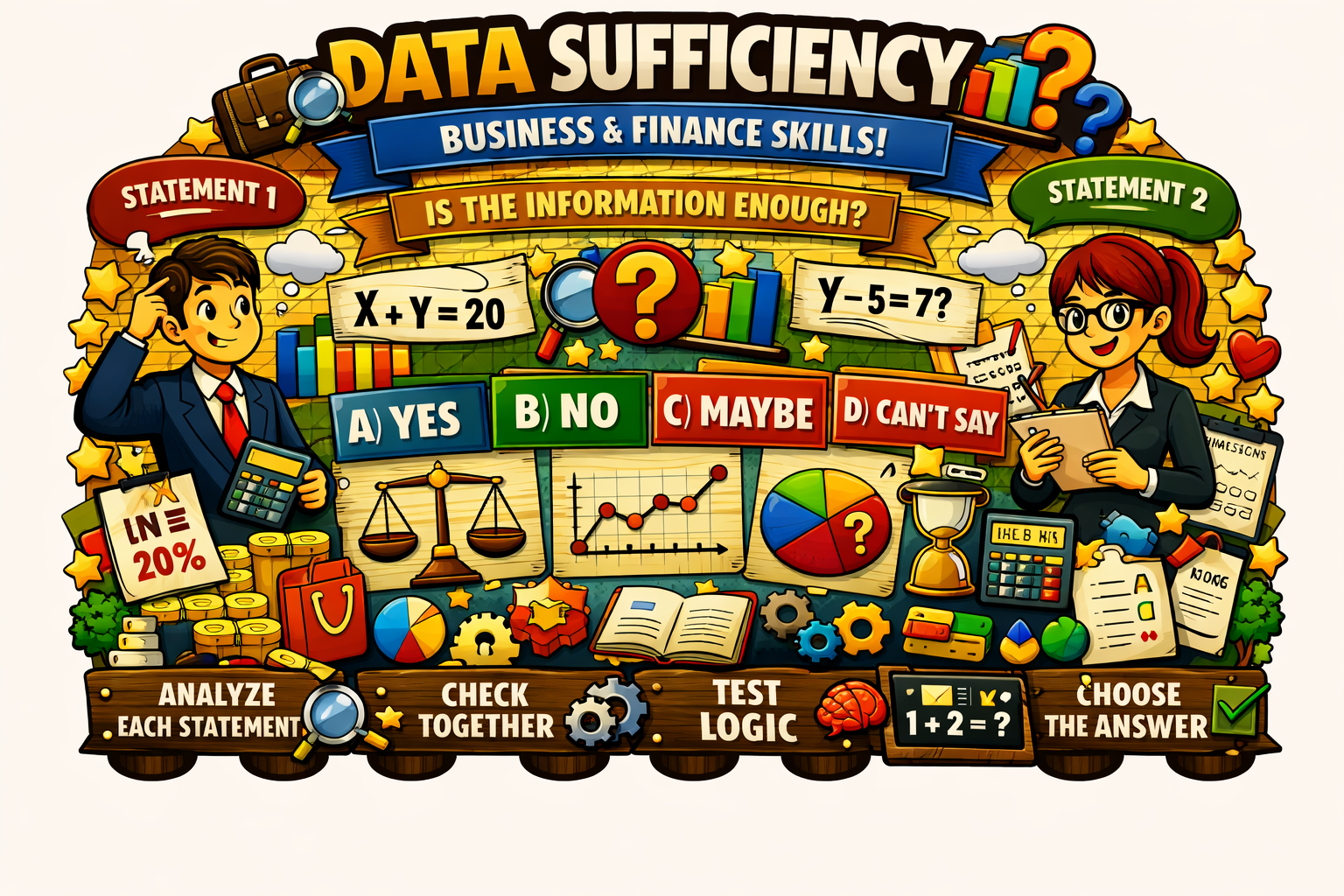
In Data Sufficiency questions, a main question is given along with statements such as Statement I and Statement II. You must decide whether Statement I alone is sufficient, Statement II alone is sufficient, both together are sufficient, or even both together are not sufficient.
These questions test logical judgment, not only calculation. The answer depends on whether the data is enough to reach a definite conclusion.
| Question | Statement | Sufficiency Check |
|---|---|---|
| Find \(x\). | \(x + 5 = 12\) | Sufficient, because \(x\) can be found uniquely. |
| Is \(x\) even? | \(x = 2k\), where \(k\) is an integer | Sufficient, because \(x\) must be even. |
| Find two numbers. | Their sum is \(20\) | Not sufficient, because many pairs can have sum \(20\). |
| Find the area of a rectangle. | Length is \(10\) | Not sufficient, because breadth is missing. |
“In Data Sufficiency, the aim is to decide whether the data is enough, not always to find the answer.”
Key points
- Check each statement independently first.
- Do not combine statements too early.
- Look for a unique answer or definite yes/no.
- A statement may give information but still be insufficient.
- Both statements together may become sufficient.
- Data sufficiency is about adequacy, not lengthy solving.
Standard Answer Pattern
Many competitive exams use a standard option pattern for Data Sufficiency questions. Always read the actual exam instructions, but the following pattern is commonly used.
| Option | Meaning | When to Choose |
|---|---|---|
| A | Statement I alone is sufficient. | Choose when Statement I alone answers the question, but Statement II alone does not. |
| B | Statement II alone is sufficient. | Choose when Statement II alone answers the question, but Statement I alone does not. |
| C | Either Statement I alone or Statement II alone is sufficient. | Choose when both statements separately answer the question. |
| D | Both statements together are sufficient, but neither alone is sufficient. | Choose when each statement alone fails, but together they answer the question. |
| E | Even both statements together are not sufficient. | Choose when the answer cannot be determined even after combining both statements. |
Common Types of Data Sufficiency Questions
Data sufficiency questions may come from arithmetic, algebra, geometry, comparison, direction, blood relation, coding, ranking, or general logical reasoning.
Numerical Sufficiency
Decide whether numbers are enough.
- Find \(x\)
- Find average
- Find percentage
- Check unique value
Algebraic Sufficiency
Decide whether equations are enough.
- One unknown
- Two unknowns
- Equation count
- Unique solution
Comparison Sufficiency
Decide whether comparison can be made.
- Is \(x > y\)?
- Who is taller?
- Which number is greater?
- Definite relation needed
Reasoning Sufficiency
Decide whether clues are enough.
- Blood relation
- Direction sense
- Ranking
- Seating clues
Sufficiency Pattern Bank
Sufficient only if the answer is definitely yes or definitely no.
Tip: For calculation questions, check whether the data gives a unique numerical value.
Step-by-Step Solving Method
| Step | Action | Example |
|---|---|---|
| Step 1 | Read the main question carefully. | Find the value of \(x\). |
| Step 2 | Check Statement I alone. | \(x + 5 = 15\), so \(x = 10\). Statement I is sufficient. |
| Step 3 | Check Statement II alone. | \(2x = 20\), so \(x = 10\). Statement II is also sufficient. |
| Step 4 | If neither alone is sufficient, combine both. | \(x + y = 20\) and \(x - y = 4\) together can find \(x\). |
| Step 5 | Select the correct sufficiency option. | If both statements separately work, choose option C. |
Solved Examples
| Question | Statements | Analysis | Answer |
|---|---|---|---|
| What is the value of \(x\)? |
I. \(x + 5 = 12\) II. \(x\) is a prime number less than \(10\) |
Statement I gives \(x = 7\), so it is sufficient. Statement II gives possible values \(2, 3, 5, 7\), so it is not sufficient. |
A |
| What is the area of a rectangle? |
I. Length is \(10\) cm. II. Breadth is \(6\) cm. |
I alone is not sufficient because breadth is missing. II alone is not sufficient because length is missing. Together: \[ A = l \times b = 10 \times 6 = 60 \] So both together are sufficient. |
D |
| Is \(x\) an even number? |
I. \(x = 2k\), where \(k\) is an integer. II. \(x\) is divisible by \(4\). |
I alone says \(x\) is even, so sufficient. II alone also says \(x\) is even, so sufficient. |
C |
| Find the value of \(x\). |
I. \(x + y = 15\) II. \(y = 5\) |
I alone is not sufficient because \(x\) and \(y\) both are unknown. II alone is not sufficient because it gives only \(y\). Together: \[ x + 5 = 15 \Rightarrow x = 10 \] |
D |
| What is the value of \(x\)? |
I. \(x > 5\) II. \(x < 10\) |
Together, \(5 < x < 10\). Many values are possible. So even both statements together are not sufficient. | E |
| Who is older, A or B? |
I. A is older than C. II. B is younger than C. |
I alone does not compare A and B. II alone does not compare A and B. Together, A is older than C and B is younger than C. Therefore, A is older than B. |
D |
| What is the average of 5 numbers? |
I. Their total is \(100\). II. The largest number is \(30\). |
I alone is sufficient because: \[ \text{Average} = \frac{100}{5} = 20 \] II alone is not sufficient. | A |
| Is \(n\) divisible by \(3\)? |
I. Sum of digits of \(n\) is divisible by \(3\). II. \(n\) is an even number. |
I alone is sufficient because divisibility by \(3\) depends on digit sum. II alone is not sufficient. |
A |
Note: For yes/no questions, a statement is sufficient if it gives a definite yes or a definite no.
Common Traps and Shortcuts
Common Traps
- Solving fully instead of checking sufficiency.
- Combining statements before testing them separately.
- Thinking partial information is sufficient.
- Ignoring multiple possible answers.
- Confusing definite yes/no with maybe.
- Choosing both together even when one alone is sufficient.
Useful Shortcuts
- Test Statement I alone first.
- Test Statement II alone next.
- Combine only if both alone fail.
- For value questions, check whether one unique value is possible.
- For yes/no questions, check whether answer is definitely yes or no.
- Do not calculate beyond what is needed.
Practice
A) Multiple Choice Questions
Use the following option pattern:
A. Statement I alone is sufficient
B. Statement II alone is sufficient
C. Either statement alone is sufficient
D. Both together are sufficient, but neither alone
E. Even both together are not sufficient
-
What is the value of \(x\)?
I. \(x + 4 = 11\)
II. \(x\) is less than \(10\)A B C D E -
What is the area of a rectangle?
I. Length is \(12\) cm.
II. Breadth is \(5\) cm.A B C D E -
Is \(n\) an odd number?
I. \(n\) is not divisible by \(2\).
II. \(n = 2k + 1\), where \(k\) is an integer.A B C D E -
Find \(x\).
I. \(x + y = 18\)
II. \(y = 8\)A B C D E -
Is \(x > 10\)?
I. \(x > 5\)
II. \(x < 20\)A B C D E
B) Solve the Higher-Order Problems
-
Who is taller, A or B?
I. A is taller than C.
II. C is taller than B. (Hint: Compare A, C, and B together.) -
What is the average of 4 numbers?
I. Their total is \(80\).
II. One of the numbers is \(20\). (Hint: Average requires total and count.) -
Is \(n\) divisible by \(5\)?
I. Last digit of \(n\) is \(0\).
II. \(n\) is divisible by \(10\). (Hint: Divisibility by 5 depends on last digit.) -
What is the value of \(x\)?
I. \(2x + y = 20\)
II. \(y = 6\) (Hint: Substitute Statement II into Statement I.) -
What is the perimeter of a square?
I. One side of the square is \(9\) cm.
II. Area of the square is \(81 \text{ cm}^2\). (Hint: Either side or area can give side length.)
C) Match the Case with the Correct Sufficiency Type
| Case | Correct Sufficiency Type |
|---|---|
| Statement I alone gives one definite answer | Option A |
| Statement II alone gives one definite answer | Option B |
| Either statement alone gives the answer | Option C |
| Both statements together are needed | Option D |
| Even both together do not give a definite answer | Option E |
| Statement gives multiple possible values | Insufficient |
Reasoning Reminder
Data Sufficiency questions are solved by checking whether the given statements provide enough information to answer the question definitely. Test each statement separately first, then combine them only if required.
Task: Create five data sufficiency questions using arithmetic, algebra, comparison, geometry, and yes/no logic.
Show Suggested Answers
Multiple Choice
-
A
Statement I gives: \[ x + 4 = 11 \Rightarrow x = 7 \] So Statement I alone is sufficient. Statement II alone gives many possible values. -
D
Area of rectangle: \[ A = l \times b \] Statement I alone gives only length. Statement II alone gives only breadth. Together they are sufficient: \[ A = 12 \times 5 = 60 \] -
C
Statement I says \(n\) is not divisible by \(2\), so \(n\) is odd. Statement II says: \[ n = 2k + 1 \] which also means \(n\) is odd. Either alone is sufficient. -
D
Statement I alone has two unknowns. Statement II alone gives only \(y\). Together: \[ x + 8 = 18 \Rightarrow x = 10 \] So both together are sufficient. -
E
Statement I says \(x > 5\). Statement II says \(x < 20\). Together: \[ 5 < x < 20 \] This does not definitely answer whether \(x > 10\). For example, \(x = 8\) gives no, but \(x = 15\) gives yes.
Higher-Order Problems
- A is taller than C and C is taller than B. Therefore: \[ A > C > B \] So A is taller than B. Both together are sufficient. Answer = D.
- Average of 4 numbers: \[ \text{Average} = \frac{\text{Total}}{4} \] Statement I alone gives total \(80\), so average \(= 20\). Statement II alone is not sufficient. Answer = A.
- Statement I says last digit is \(0\), so \(n\) is divisible by \(5\). Statement II says \(n\) is divisible by \(10\), so it is also divisible by \(5\). Either alone is sufficient. Answer = C.
- Statement I alone has two unknowns. Statement II gives \(y = 6\). Together: \[ 2x + 6 = 20 \] \[ 2x = 14 \] \[ x = 7 \] Answer = D.
- Perimeter of square: \[ P = 4s \] Statement I gives side \(s = 9\), so sufficient. Statement II gives: \[ s^2 = 81 \Rightarrow s = 9 \] so it is also sufficient. Answer = C.
Concept Matching
- Statement I alone gives one definite answer → Option A
- Statement II alone gives one definite answer → Option B
- Either statement alone gives the answer → Option C
- Both statements together are needed → Option D
- Even both together do not give a definite answer → Option E
- Statement gives multiple possible values → Insufficient
Clue Explanation
In Data Sufficiency, a statement is sufficient only when it gives one definite answer. If a statement allows multiple possible answers, it is not sufficient.
Exam tips
- Check Statement I alone first.
- Check Statement II alone separately.
- Combine statements only after both fail separately.
- Look for a unique value or definite yes/no answer.
- Do not overcalculate when sufficiency is already clear.
- Always follow the option pattern given in the exam.