Commercial Mathematics
Practice MCQsCommercial Mathematics deals with real-life calculations related to buying, selling, profit, loss, discount, tax, interest, bills, and investments.
Commercial Mathematics deals with real-life calculations related to buying, selling, profit, loss, discount, tax, interest, bills, and investments. It is one of the most practical topics in mathematics and is very useful in business, banking, shopping, finance, and competitive examinations.
What is Commercial Mathematics?
Commercial Mathematics is the branch of mathematics that helps us understand money-related calculations in daily life and business.
It includes topics such as profit and loss, discount, tax, simple interest, compound interest, percentage, and billing calculations.
| Term | Meaning | Example |
|---|---|---|
| Cost Price | Price at which an article is bought | Shopkeeper buys a pen for ₹\(20\) |
| Selling Price | Price at which an article is sold | Shopkeeper sells the pen for ₹\(25\) |
| Marked Price | Price printed or displayed on an item | MRP of a shirt is ₹\(1000\) |
| Discount | Reduction given on marked price | \(10\%\) off on MRP |
| Tax | Extra amount added to price by government rules | GST added to bill amount |
“Commercial mathematics connects classroom mathematics with real-world money decisions.”
Key points
- Cost Price is also called CP.
- Selling Price is also called SP.
- Profit occurs when SP is greater than CP.
- Loss occurs when CP is greater than SP.
- Discount is calculated on marked price.
- Interest is calculated on principal amount.
Important Terms in Commercial Mathematics
To solve commercial mathematics problems, first understand the meaning of commonly used terms.
Cost Price
The price at which an item is purchased.
- Short form is CP.
- It is the buying price.
- Used to calculate profit or loss.
Selling Price
The price at which an item is sold.
- Short form is SP.
- It is the sale price.
- Compare with CP to find profit or loss.
Marked Price
The price printed or displayed before discount.
- Short form is MP.
- Also called list price.
- Discount is calculated on MP.
Principal
The original amount borrowed or invested.
- Short form is P.
- Interest is calculated on it.
- Used in banking and loans.
Profit and Loss
Profit or loss is found by comparing the selling price with the cost price.
| Concept | Formula | Use |
|---|---|---|
| Profit | \[ Profit = SP - CP \] | Used when \(SP > CP\) |
| Loss | \[ Loss = CP - SP \] | Used when \(CP > SP\) |
| Profit Percentage | \[ Profit\% = \frac{Profit}{CP} \times 100 \] | Profit as a percentage of cost price |
| Loss Percentage | \[ Loss\% = \frac{Loss}{CP} \times 100 \] | Loss as a percentage of cost price |
| SP from Profit % | \[ SP = CP \times \frac{100 + Profit\%}{100} \] | Used when CP and profit percentage are given |
| SP from Loss % | \[ SP = CP \times \frac{100 - Loss\%}{100} \] | Used when CP and loss percentage are given |
Discount, Marked Price and Tax
Discount is a reduction from the marked price. Tax is usually added to the price after discount.
| Concept | Formula | Meaning |
|---|---|---|
| Discount | \[ Discount = MP - SP \] | Reduction from marked price |
| Discount Percentage | \[ Discount\% = \frac{Discount}{MP} \times 100 \] | Discount as a percentage of marked price |
| Selling Price after Discount | \[ SP = MP \times \frac{100 - Discount\%}{100} \] | Final price before tax |
| Tax Amount | \[ Tax = Price \times \frac{Tax\%}{100} \] | Extra amount added to bill |
| Final Bill Amount | \[ Final\ Amount = Price + Tax \] | Amount paid by customer |
Simple Interest and Compound Interest
Interest is the extra money paid for borrowing money or earned from investing money.
| Concept | Formula | Meaning of Symbols |
|---|---|---|
| Simple Interest | \[ SI = \frac{P \times R \times T}{100} \] | \(P\) = Principal, \(R\) = Rate, \(T\) = Time |
| Amount in Simple Interest | \[ A = P + SI \] | Total money after interest |
| Compound Amount | \[ A = P\left(1 + \frac{R}{100}\right)^T \] | Amount when interest is compounded annually |
| Compound Interest | \[ CI = A - P \] | Interest on principal and previous interest |
Types of Commercial Mathematics Questions
Tip: Read carefully whether the question asks for amount, interest, price, profit, loss, or percentage.
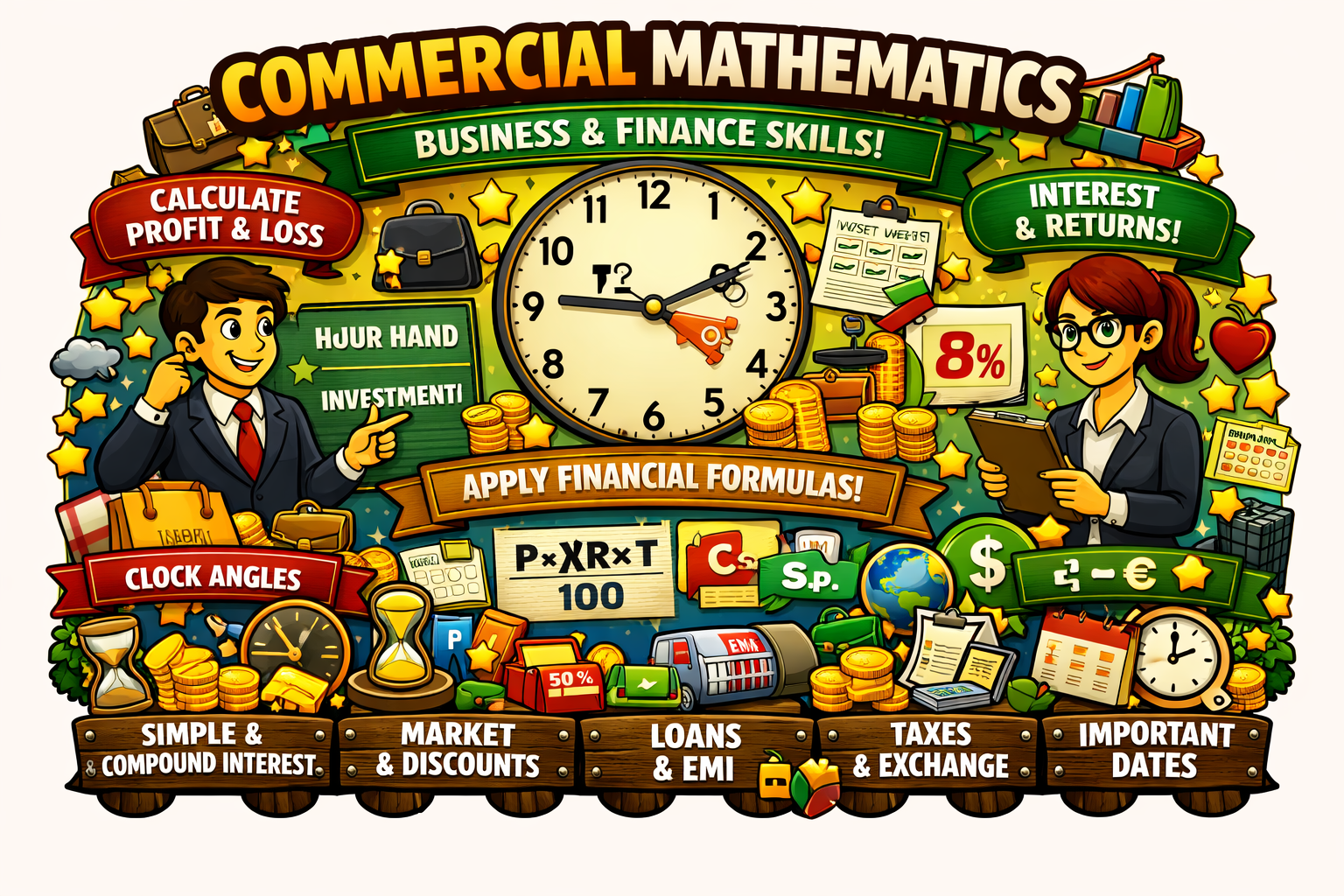
Step-by-Step Method to Solve Problems
| Step | What to Do | Example Idea |
|---|---|---|
| Step 1 | Identify the topic. | Profit-loss, discount, tax, SI, or CI |
| Step 2 | Write the given values clearly. | CP = ₹\(500\), SP = ₹\(600\) |
| Step 3 | Select the correct formula. | \(Profit = SP - CP\) |
| Step 4 | Substitute values carefully. | \(Profit = 600 - 500\) |
| Step 5 | Write final answer with unit. | Profit = ₹\(100\) |
Solved Examples
| Question | Method | Answer |
|---|---|---|
| An article is bought for ₹\(500\) and sold for ₹\(650\). Find the profit. | \[ Profit = SP - CP = 650 - 500 \] | ₹\(150\) |
| An article is bought for ₹\(800\) and sold for ₹\(720\). Find the loss percentage. | \[ Loss = 800 - 720 = 80 \] \[ Loss\% = \frac{80}{800} \times 100 = 10\% \] | \(10\%\) loss |
| A shirt marked at ₹\(1200\) is sold at \(20\%\) discount. Find the selling price. | \[ Discount = 1200 \times \frac{20}{100} = 240 \] \[ SP = 1200 - 240 = 960 \] | ₹\(960\) |
| A bill amount is ₹\(2000\). GST is \(18\%\). Find the final amount. | \[ GST = 2000 \times \frac{18}{100} = 360 \] \[ Final\ Amount = 2000 + 360 = 2360 \] | ₹\(2360\) |
| Find simple interest on ₹\(5000\) at \(10\%\) per annum for \(2\) years. | \[ SI = \frac{P \times R \times T}{100} = \frac{5000 \times 10 \times 2}{100} \] | ₹\(1000\) |
| Find the amount on ₹\(4000\) at \(5\%\) simple interest for \(3\) years. | \[ SI = \frac{4000 \times 5 \times 3}{100} = 600 \] \[ A = P + SI = 4000 + 600 \] | ₹\(4600\) |
| A product has MP ₹\(1500\). Discount is \(10\%\), then tax is \(12\%\) on discounted price. Find final amount. | \[ Discount = 1500 \times \frac{10}{100} = 150 \] \[ Discounted\ Price = 1500 - 150 = 1350 \] \[ Tax = 1350 \times \frac{12}{100} = 162 \] \[ Final\ Amount = 1350 + 162 = 1512 \] | ₹\(1512\) |
Note: In multi-step bill problems, follow the correct order: marked price → discount → tax → final amount.
Common Mistakes and How to Avoid Them
Common Mistakes
- Calculating profit percentage on SP instead of CP.
- Calculating discount on CP instead of MP.
- Adding tax before applying discount when the question asks otherwise.
- Confusing simple interest and compound interest.
- Forgetting to write rupees or percentage in final answer.
- Using wrong formula for finding SP from profit or loss percentage.
Useful Shortcuts
- Profit means \(SP > CP\).
- Loss means \(CP > SP\).
- Profit and loss percentages are based on CP.
- Discount percentage is based on MP.
- Simple Interest uses \(SI = \frac{PRT}{100}\).
- Amount means principal plus interest.
Quick Formula Revision
Profit / Loss
\[ Profit = SP - CP \]
\[ Loss = CP - SP \]
Percentage
\[ Profit\% = \frac{Profit}{CP} \times 100 \]
\[ Loss\% = \frac{Loss}{CP} \times 100 \]
Discount
\[ Discount = MP - SP \]
\[ SP = MP \times \frac{100-D\%}{100} \]
Interest
\[ SI = \frac{PRT}{100} \]
\[ A = P + SI \]
Practice
A) Multiple Choice Questions
-
If CP is ₹\(500\) and SP is ₹\(600\), the profit is:
₹\(50\) ₹\(100\) ₹\(150\) ₹\(200\)
-
Profit percentage is calculated on:
SP CP MP Discount
-
Discount is calculated on:
CP SP MP Profit
-
The formula for Simple Interest is:
\(P + R + T\) \(\frac{PRT}{100}\) \(P \times R\) \(\frac{P}{RT}\)
-
If an item is sold for less than its cost price, it is:
Profit Loss Discount Tax
B) Solve the Problems
- An article is bought for ₹\(900\) and sold for ₹\(1080\). Find the profit percentage. Hint: Use \(Profit\% = \frac{Profit}{CP} \times 100\).
- A product marked at ₹\(2000\) is sold at \(15\%\) discount. Find the selling price. Hint: First calculate discount.
- Find simple interest on ₹\(6000\) at \(8\%\) per annum for \(3\) years. Hint: Use \(SI = \frac{PRT}{100}\).
- A bill is ₹\(2500\). GST is \(12\%\). Find the final bill amount. Hint: Add GST to bill amount.
- An item is sold for ₹\(760\) at a loss of ₹\(40\). Find the cost price. Hint: \(CP = SP + Loss\).
C) Match the Concept with the Correct Formula
| Concept | Correct Formula / Meaning |
|---|---|
| Profit | \(SP - CP\) |
| Loss | \(CP - SP\) |
| Profit Percentage | \(\frac{Profit}{CP} \times 100\) |
| Discount | \(MP - SP\) |
| Simple Interest | \(\frac{PRT}{100}\) |
| Amount | \(P + Interest\) |
Commercial Mathematics Reminder
Commercial mathematics is highly practical. To master it, practise problems based on shopping bills, discounts, GST, bank interest, profit, loss, and selling price.
Task: Create five real-life bill examples and calculate discount, tax, and final amount.
Show Suggested Answers
Multiple Choice
-
₹\(100\)
\[ Profit = SP - CP = 600 - 500 = 100 \] -
CP
Profit percentage is always calculated on cost price. -
MP
Discount is calculated on marked price. -
\(\frac{PRT}{100}\)
This is the formula for simple interest. -
Loss
If selling price is less than cost price, there is a loss.
Solved Problems
- \[ Profit = 1080 - 900 = 180 \] \[ Profit\% = \frac{180}{900} \times 100 = 20\% \]
- \[ Discount = 2000 \times \frac{15}{100} = 300 \] \[ SP = 2000 - 300 = 1700 \] Answer = ₹\(1700\)
- \[ SI = \frac{6000 \times 8 \times 3}{100} = 1440 \] Answer = ₹\(1440\)
- \[ GST = 2500 \times \frac{12}{100} = 300 \] \[ Final\ Amount = 2500 + 300 = 2800 \] Answer = ₹\(2800\)
- \[ CP = SP + Loss = 760 + 40 = 800 \] Answer = ₹\(800\)
Concept Matching
- Profit → \(SP - CP\)
- Loss → \(CP - SP\)
- Profit Percentage → \(\frac{Profit}{CP} \times 100\)
- Discount → \(MP - SP\)
- Simple Interest → \(\frac{PRT}{100}\)
- Amount → \(P + Interest\)
Clue Explanation
Profit and loss depend on CP and SP. Discount depends on MP. Interest depends on principal, rate, and time. In every problem, identify the base amount first.
Exam tips
- Profit and loss percentages are calculated on CP.
- Discount percentage is calculated on MP.
- Tax is usually added after discount.
- Simple interest is calculated on principal only.
- Amount means principal plus interest.
- Always write ₹ or % in the final answer.