Averages
Practice MCQsAverages, also known as means, represent a central value obtained by summing a set of numbers and dividing by the count of numbers in the set. Averages provide a useful summary of data, helping to understand the typical or representative value of a group and allowing for comparisons and analysis.
Averages help us find a single representative value for a group of numbers. This topic is very important in school mathematics, competitive exams, data interpretation, marks analysis, speed calculations, income problems, and mixture-based questions.
What is Average?
An average is a value that represents the central or typical value of a group of numbers. It is found by dividing the sum of all observations by the number of observations.
For example, if the marks of five students are \(40, 50, 60, 70,\) and \(80\), then their average marks are:
\[ Average = \frac{40 + 50 + 60 + 70 + 80}{5} = \frac{300}{5} = 60 \]
| Term | Meaning | Example |
|---|---|---|
| Observation | Each individual value in a group | \(10, 20, 30\) |
| Sum | Total of all observations | \(10 + 20 + 30 = 60\) |
| Number of Observations | Count of values | \(3\) |
| Average | Representative value | \(\frac{60}{3} = 20\) |
“Average gives us one value that represents the whole group.”
Key points
- Average is also called arithmetic mean.
- Average depends on total sum and number of values.
- All values must be in the same unit.
- Average may not always be one of the given values.
- Average changes when a new value is added or removed.
- Combined average is useful for groups.
Important Average Formulas
Most average problems can be solved using a few standard formulas.
| Formula Type | Formula | Use |
|---|---|---|
| Basic Average | \[ Average = \frac{Sum}{Number} \] | To find average when sum and count are known. |
| Sum from Average | \[ Sum = Average \times Number \] | To find total when average and count are known. |
| Number from Sum and Average | \[ Number = \frac{Sum}{Average} \] | To find number of observations. |
| Combined Average | \[ Combined\ Average = \frac{n_1a_1 + n_2a_2}{n_1+n_2} \] | To find average of two groups together. |
| Weighted Average | \[ Weighted\ Average = \frac{w_1x_1 + w_2x_2 + \cdots}{w_1+w_2+\cdots} \] | Used when values have different weights. |
Important Concepts in Averages
Arithmetic Mean
The usual average of numbers.
- Add all values.
- Divide by number of values.
- Most common type of average.
Combined Average
Average of two or more groups together.
- Find total of each group.
- Add all totals.
- Divide by total number.
Weighted Average
Used when values have different importance or weights.
- Useful in marks and price problems.
- Weights are multiplied with values.
- Then divide by total weight.
Change in Average
Average changes when a value is added, removed, or replaced.
- New total must be calculated.
- New number must be checked.
- Then find new average.
Types of Average Questions
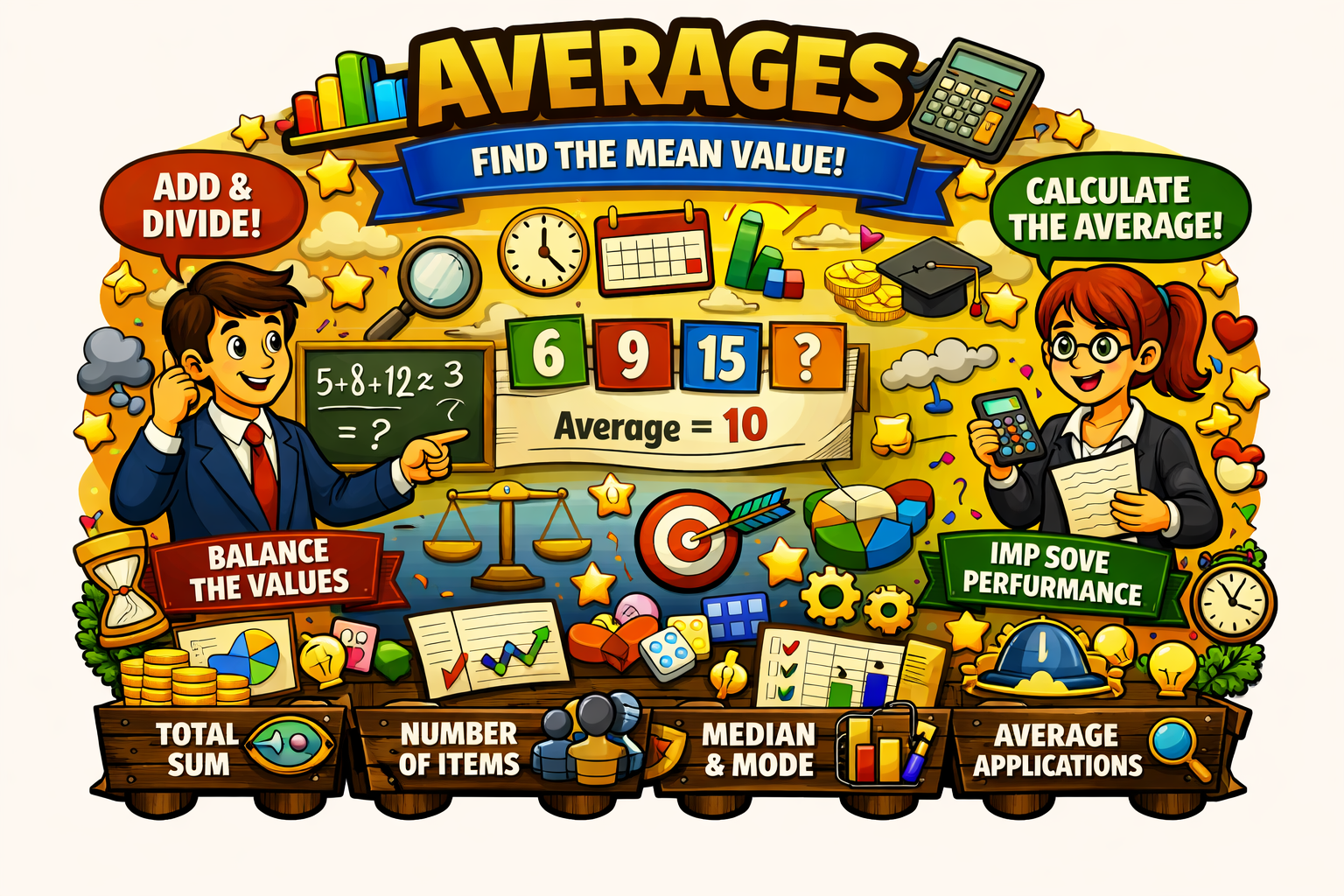
Example: Average of \(5, 10, 15\).
Use \(Sum = Average \times Number\).
Useful for class, team, or salary questions.
Find old total and new total.
Tip: In competitive exams, most average problems are actually total-sum problems.
Step-by-Step Method to Solve Average Problems
| Step | What to Do | Example Idea |
|---|---|---|
| Step 1 | Identify the number of observations. | There are \(5\) students. |
| Step 2 | Find or calculate the total sum. | \(Total = Average \times Number\) |
| Step 3 | Apply addition, removal, or replacement if needed. | Add new value or subtract removed value. |
| Step 4 | Divide by the final number of observations. | \(New\ Average = \frac{New\ Total}{New\ Number}\) |
| Step 5 | Write the answer with proper unit. | marks, kg, runs, years, rupees, etc. |
Solved Examples
| Question | Method | Answer |
|---|---|---|
| Find the average of \(10, 20, 30, 40\). | \[ Average = \frac{10+20+30+40}{4} = \frac{100}{4} \] | \(25\) |
| The average of \(6\) numbers is \(15\). Find their sum. | \[ Sum = Average \times Number = 15 \times 6 \] | \(90\) |
| The average marks of \(5\) students is \(60\). A new student with \(72\) marks joins. Find the new average. |
\[
Old\ Total = 5 \times 60 = 300
\] \[ New\ Total = 300 + 72 = 372 \] \[ New\ Average = \frac{372}{6} \] |
\(62\) |
| The average age of \(4\) persons is \(25\). If one person aged \(20\) leaves, find the new average. |
\[
Old\ Total = 4 \times 25 = 100
\] \[ New\ Total = 100 - 20 = 80 \] \[ New\ Average = \frac{80}{3} \] |
\(26.67\) |
| Average salary of \(10\) workers is ₹\(12000\). Average salary of \(5\) managers is ₹\(30000\). Find combined average salary. |
\[
Combined\ Average =
\frac{10 \times 12000 + 5 \times 30000}{10+5}
\] \[ = \frac{120000 + 150000}{15} = \frac{270000}{15} \] |
₹\(18000\) |
| The average of \(8\) numbers is \(20\). If one number is wrongly written as \(36\) instead of \(26\), find the correct average. |
\[
Wrong\ Total = 8 \times 20 = 160
\] \[ Correct\ Total = 160 - 36 + 26 = 150 \] \[ Correct\ Average = \frac{150}{8} \] |
\(18.75\) |
Note: In replacement or correction problems, always adjust the total first and then divide by the number of observations.
Special Rules and Shortcuts
| Situation | Shortcut / Rule | Example |
|---|---|---|
| All values increase by same number | Average increases by same number. | If each value increases by \(5\), average also increases by \(5\). |
| All values decrease by same number | Average decreases by same number. | If each value decreases by \(3\), average also decreases by \(3\). |
| All values multiply by same number | Average is also multiplied by that number. | If all values are doubled, average is also doubled. |
| All values divide by same number | Average is also divided by that number. | If all values are halved, average is also halved. |
| Consecutive numbers | Average is the middle value. | Average of \(3,4,5,6,7\) is \(5\). |
| Consecutive even or odd numbers | Average is the middle term. | Average of \(2,4,6,8,10\) is \(6\). |
Common Mistakes and How to Avoid Them
Common Mistakes
- Dividing by the wrong number of observations.
- Forgetting to update the total when a value is added.
- Forgetting to reduce the count when a value is removed.
- Using simple average instead of weighted average.
- Not correcting wrongly entered values properly.
- Ignoring units such as marks, kg, years, or rupees.
Useful Shortcuts
- First convert average into total sum.
- Use \(Sum = Average \times Number\).
- For group average, calculate group totals separately.
- For correction problems, subtract the wrong value and add the correct value.
- For consecutive values, use the middle value.
- Always check whether the number of observations has changed.
Quick Formula Revision
Basic Average
\[ Average = \frac{Sum}{Number} \]
Total Sum
\[ Sum = Average \times Number \]
Combined Average
\[ \frac{n_1a_1+n_2a_2}{n_1+n_2} \]
Corrected Average
\[ \frac{Old\ Total - Wrong + Correct}{Number} \]
Practice
A) Multiple Choice Questions
-
Find the average of \(5, 10, 15, 20\).
\(10\) \(12.5\) \(15\) \(20\)
-
If the average of \(8\) numbers is \(12\), what is their sum?
\(80\) \(88\) \(96\) \(100\)
-
Average of consecutive numbers \(11, 12, 13, 14, 15\) is:
\(12\) \(13\) \(14\) \(15\)
-
The average of \(4\) numbers is \(25\). If a fifth number \(30\) is added, the new average is:
\(25\) \(26\) \(27\) \(28\)
-
Which formula is used to find the total sum?
\(Average + Number\) \(Average - Number\) \(Average \times Number\) \(Average \div Number\)
B) Solve the Problems
- Find the average of \(18, 22, 30, 40, 50\). Hint: Add all numbers and divide by \(5\).
- Average marks of \(6\) students is \(45\). Find the total marks. Hint: Use \(Sum = Average \times Number\).
- The average of \(5\) numbers is \(20\). A new number \(40\) is added. Find the new average. Hint: First find old total.
- Average age of \(10\) persons is \(30\). One person aged \(40\) leaves. Find the new average. Hint: Subtract \(40\) from total and divide by \(9\).
- Average of \(12\) numbers is \(18\). One number was wrongly taken as \(30\) instead of \(24\). Find the correct average. Hint: Correct the total first.
C) Match the Concept with the Correct Meaning
| Concept | Correct Meaning / Formula |
|---|---|
| Average | \(\frac{Sum}{Number}\) |
| Sum | \(Average \times Number\) |
| Combined Average | Average of two or more groups together |
| Weighted Average | Average where values have different weights |
| Consecutive Numbers | Average is the middle value |
| Correction Problem | Subtract wrong value and add correct value |
Average Reminder
Averages become very easy when you focus on the total sum. In almost every question, the first step is to calculate the total using the average and the number of observations.
Task: Create five average problems from daily life, such as average marks, average age, average salary, average speed, or average runs.
Show Suggested Answers
Multiple Choice
-
\(12.5\)
\[ Average = \frac{5+10+15+20}{4} = \frac{50}{4} = 12.5 \] -
\(96\)
\[ Sum = 8 \times 12 = 96 \] -
\(13\)
The middle value of \(11,12,13,14,15\) is \(13\). -
\(26\)
\[ Old\ Total = 4 \times 25 = 100 \] \[ New\ Total = 100 + 30 = 130 \] \[ New\ Average = \frac{130}{5} = 26 \] -
\(Average \times Number\)
Total sum is found by multiplying average with number of observations.
Solved Problems
- \[ Average = \frac{18+22+30+40+50}{5} = \frac{160}{5} = 32 \]
- \[ Total = 45 \times 6 = 270 \]
- \[ Old\ Total = 5 \times 20 = 100 \] \[ New\ Total = 100 + 40 = 140 \] \[ New\ Average = \frac{140}{6} = 23.33 \]
- \[ Old\ Total = 10 \times 30 = 300 \] \[ New\ Total = 300 - 40 = 260 \] \[ New\ Average = \frac{260}{9} = 28.89 \]
- \[ Wrong\ Total = 12 \times 18 = 216 \] \[ Correct\ Total = 216 - 30 + 24 = 210 \] \[ Correct\ Average = \frac{210}{12} = 17.5 \]
Concept Matching
- Average → \(\frac{Sum}{Number}\)
- Sum → \(Average \times Number\)
- Combined Average → Average of two or more groups together
- Weighted Average → Average where values have different weights
- Consecutive Numbers → Average is the middle value
- Correction Problem → Subtract wrong value and add correct value
Clue Explanation
Average questions are best solved by finding the total sum first. After that, apply the change mentioned in the question and divide by the final number of observations.
Exam tips
- Convert average into total sum first.
- Check whether a value is added, removed, or replaced.
- Do not forget to change the number of observations.
- For combined average, calculate total of each group.
- For correction questions, subtract wrong and add correct.
- Always write the unit where required.