Clocks and Calendars
Practice MCQsClocks and Calendars are important aptitude topics used to test logical thinking, time calculation, angle calculation, day-date relation, leap years, odd days, and calendar patterns.
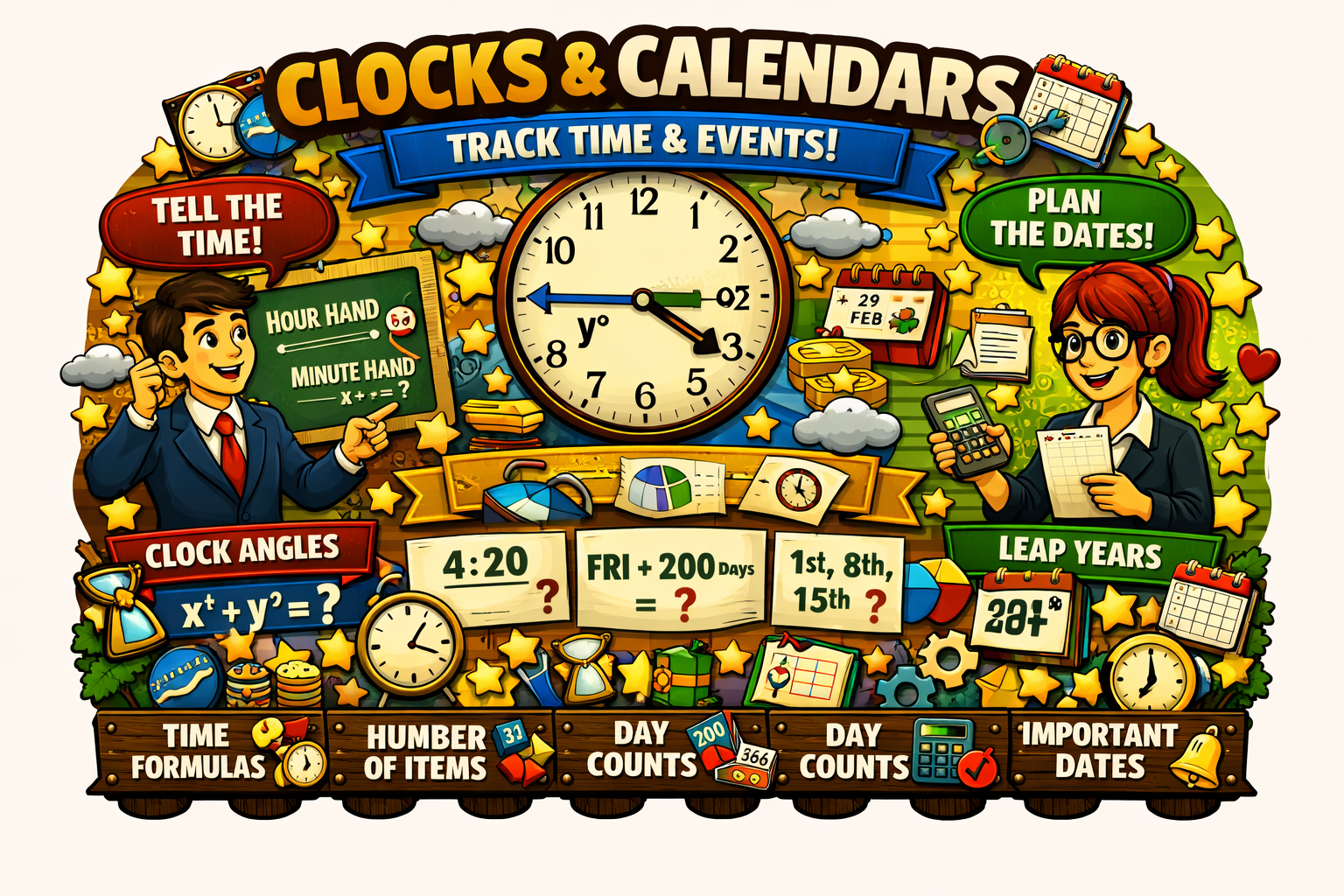
Clocks and Calendars are important aptitude topics used to test logical thinking, time calculation, angle calculation, day-date relation, leap years, odd days, and calendar patterns. These questions are common in school-level exams, competitive exams, and reasoning tests.
What are Clocks and Calendars?
Clock problems usually involve angles between hands, overlapping of hands, opposite directions, right angles, and time gained or lost by a clock.
Calendar problems involve finding the day of the week for a given date, leap year calculations, odd days, repeated calendars, and number of Sundays or specific days in a month or year.
| Topic | Main Concept | Example Question |
|---|---|---|
| Clock | Angle between hands | Find the angle at \(3:30\). |
| Clock | Hands overlapping | When do hands coincide? |
| Calendar | Odd days | Find the day on a given date. |
| Calendar | Leap year | Is \(2024\) a leap year? |
“Clock and calendar problems become simple when formulas and patterns are understood clearly.”
Key points
- A clock has \(360^\circ\).
- Each hour mark represents \(30^\circ\).
- Minute hand moves \(6^\circ\) per minute.
- Hour hand moves \(0.5^\circ\) per minute.
- A normal year has \(365\) days.
- A leap year has \(366\) days.
Clock Basics
A clock is divided into \(12\) equal parts. The complete circle is \(360^\circ\), so the angle between two consecutive hour marks is:
| Clock Part | Movement | Important Value |
|---|---|---|
| Minute Hand | Completes \(360^\circ\) in \(60\) minutes | \(6^\circ\) per minute |
| Hour Hand | Moves \(30^\circ\) in \(60\) minutes | \(0.5^\circ\) per minute |
| Relative Speed | Minute hand gains over hour hand | \(6 - 0.5 = 5.5^\circ\) per minute |
| Hour Mark Gap | Angle between two adjacent numbers | \(30^\circ\) |
Important Clock Formulas
The most common clock question is to find the angle between the hour hand and minute hand.
| Formula Type | Formula | Use |
|---|---|---|
| Angle Between Hands | \[ Angle = \left|30H - \frac{11M}{2}\right| \] | Used to find angle at time \(H:M\). |
| Minute Hand Movement | \[ 6^\circ \times M \] | Angle moved by minute hand in \(M\) minutes. |
| Hour Hand Movement | \[ 30H + \frac{M}{2} \] | Position of hour hand from \(12\). |
| Relative Speed | \[ 6 - 0.5 = 5.5^\circ/min \] | Used for coincidence and opposite direction problems. |
| Smaller Angle | \[ Smaller\ Angle = \min(\theta, 360^\circ - \theta) \] | Used when angle is more than \(180^\circ\). |
Calendar Basics
Calendar questions are solved using the concept of odd days. Odd days are the extra days left after complete weeks are removed.
| Period | Total Days | Odd Days |
|---|---|---|
| Normal Year | \(365\) | \(365 \div 7 = 52\) weeks + \(1\) day |
| Leap Year | \(366\) | \(366 \div 7 = 52\) weeks + \(2\) days |
| Ordinary Century | \(100\) years | \(5\) odd days |
| 400 Years | \(400\) years | \(0\) odd days |
Leap Year Rules
A leap year has \(366\) days, with February having \(29\) days.
Example: \(2024\) is a leap year.
Example: \(2000\) is a leap year.
Tip: Always check century years separately.
Odd Days in Months
To find the day for a given date, it is useful to remember the number of odd days in each month.
| Month | Days | Odd Days | Note |
|---|---|---|---|
| January | \(31\) | \(3\) | \(31 = 28 + 3\) |
| February | \(28\) or \(29\) | \(0\) or \(1\) | Depends on leap year |
| March | \(31\) | \(3\) | Same as January |
| April | \(30\) | \(2\) | \(30 = 28 + 2\) |
| May | \(31\) | \(3\) | Same as January |
| June | \(30\) | \(2\) | Same as April |
| July | \(31\) | \(3\) | Same as January |
| August | \(31\) | \(3\) | Same as January |
| September | \(30\) | \(2\) | Same as April |
| October | \(31\) | \(3\) | Same as January |
| November | \(30\) | \(2\) | Same as April |
| December | \(31\) | \(3\) | Same as January |
Odd days are calculated by dividing the number of days by \(7\) and taking the remainder.
Day Codes for Odd Days
Once total odd days are found, the day can be identified using the following table.
| Odd Days | Day |
|---|---|
| \(0\) | Sunday |
| \(1\) | Monday |
| \(2\) | Tuesday |
| \(3\) | Wednesday |
| \(4\) | Thursday |
| \(5\) | Friday |
| \(6\) | Saturday |
Solved Examples
| Question | Method | Answer |
|---|---|---|
| Find the angle between hands at \(3:00\). |
At \(3:00\), hour hand is at \(3\) and minute hand is at \(12\). \[ Angle = 3 \times 30^\circ = 90^\circ \] |
\(90^\circ\) |
| Find the angle between hands at \(4:20\). | \[ Angle = \left|30H - \frac{11M}{2}\right| \] \[ = \left|30(4) - \frac{11(20)}{2}\right| = |120 - 110| \] | \(10^\circ\) |
| Find the angle between hands at \(6:30\). | \[ Angle = \left|30(6) - \frac{11(30)}{2}\right| = |180 - 165| \] | \(15^\circ\) |
| Is \(2024\) a leap year? | \(2024\) is divisible by \(4\) and it is not a century year. | Yes, it is a leap year. |
| Is \(1900\) a leap year? | \(1900\) is divisible by \(100\), but not divisible by \(400\). | No, it is not a leap year. |
| Find odd days in a normal year. | \[ 365 = 52 \times 7 + 1 \] | \(1\) odd day |
| Find odd days in a leap year. | \[ 366 = 52 \times 7 + 2 \] | \(2\) odd days |
| If today is Monday, what day will it be after \(45\) days? | \[ 45 \div 7 = 6\ weeks + 3\ days \] Count \(3\) days after Monday. | Thursday |
Note: In clock angle problems, always take the smaller angle unless the question asks otherwise.
Common Mistakes and How to Avoid Them
Common Mistakes
- Assuming the hour hand stays exactly on the hour number after minutes pass.
- Forgetting that the hour hand moves \(0.5^\circ\) per minute.
- Taking the larger angle instead of the smaller angle.
- Confusing normal year and leap year odd days.
- Treating all century years as leap years.
- Forgetting that February has \(29\) days in a leap year.
Useful Shortcuts
- Each hour gap is \(30^\circ\).
- Minute hand moves \(6^\circ\) per minute.
- Hour hand moves \(0.5^\circ\) per minute.
- Normal year gives \(1\) odd day.
- Leap year gives \(2\) odd days.
- Century year must be divisible by \(400\) to be leap year.
Quick Formula Revision
Clock Angle
\[ \theta = \left|30H - \frac{11M}{2}\right| \]
Minute Hand
\[ 6^\circ\ per\ minute \]
Hour Hand
\[ 0.5^\circ\ per\ minute \]
Odd Days
\[ Odd\ Days = Days \bmod 7 \]
Practice
A) Multiple Choice Questions
-
What is the angle between the hour hand and minute hand at \(3:00\)?
\(30^\circ\) \(60^\circ\) \(90^\circ\) \(120^\circ\)
-
How many degrees does the minute hand move in one minute?
\(0.5^\circ\) \(3^\circ\) \(6^\circ\) \(30^\circ\)
-
A normal year has how many odd days?
\(0\) \(1\) \(2\) \(3\)
-
Which of the following is a leap year?
\(1900\) \(2023\) \(2024\) \(2100\)
-
How many odd days are there in a leap year?
\(0\) \(1\) \(2\) \(7\)
B) Solve the Problems
- Find the angle between the hands at \(2:30\). Hint: Use \(\left|30H - \frac{11M}{2}\right|\).
- Find the angle between the hands at \(5:10\). Hint: Take \(H = 5\) and \(M = 10\).
- Is \(2000\) a leap year? Hint: Century year must be divisible by \(400\).
- Is \(2100\) a leap year? Hint: Check divisibility by \(400\).
- If today is Tuesday, what day will it be after \(31\) days? Hint: Find remainder when \(31\) is divided by \(7\).
C) Match the Concept with the Correct Meaning
| Concept | Correct Meaning / Formula |
|---|---|
| Minute Hand Speed | \(6^\circ\) per minute |
| Hour Hand Speed | \(0.5^\circ\) per minute |
| Angle Between Hands | \(\left|30H - \frac{11M}{2}\right|\) |
| Normal Year | \(365\) days |
| Leap Year | \(366\) days |
| Odd Days | Remainder after dividing days by \(7\) |
Clocks and Calendars Reminder
Clock problems become easy when you remember the movement of the hour hand and minute hand. Calendar problems become easy when you remember leap-year rules and odd days.
Task: Create five clock angle problems and five calendar odd-day problems for practice.
Show Suggested Answers
Multiple Choice
-
\(90^\circ\)
At \(3:00\), the hands are separated by three hour gaps: \(3 \times 30^\circ = 90^\circ\). -
\(6^\circ\)
Minute hand completes \(360^\circ\) in \(60\) minutes, so it moves \(6^\circ\) per minute. -
\(1\)
\(365 = 52 \times 7 + 1\), so a normal year has \(1\) odd day. -
\(2024\)
\(2024\) is divisible by \(4\) and is not a century year. -
\(2\)
\(366 = 52 \times 7 + 2\), so a leap year has \(2\) odd days.
Solved Problems
-
Angle at \(2:30\):
\[ \theta = \left|30(2) - \frac{11(30)}{2}\right| = |60 - 165| = 105^\circ \] -
Angle at \(5:10\):
\[ \theta = \left|30(5) - \frac{11(10)}{2}\right| = |150 - 55| = 95^\circ \] - \(2000\) is a leap year because it is divisible by \(400\).
- \(2100\) is not a leap year because it is not divisible by \(400\).
- \[ 31 \div 7 = 4\ weeks + 3\ days \] Three days after Tuesday is Friday.
Concept Matching
- Minute Hand Speed → \(6^\circ\) per minute
- Hour Hand Speed → \(0.5^\circ\) per minute
- Angle Between Hands → \(\left|30H - \frac{11M}{2}\right|\)
- Normal Year → \(365\) days
- Leap Year → \(366\) days
- Odd Days → Remainder after dividing days by \(7\)
Clue Explanation
Clock questions depend on hand movement and relative speed. Calendar questions depend on odd days, leap-year rules, and weekly remainders.
Exam tips
- Use \(H\) in 12-hour format.
- Minute hand moves \(6^\circ\) per minute.
- Hour hand moves \(0.5^\circ\) per minute.
- Take the smaller angle unless otherwise asked.
- Check century years carefully for leap years.
- Use odd days to solve calendar questions.