Stress Management
Practice MCQsStress Management deals with understanding stress, learning to cope with stress and becoming resilient to stress. This module is envisaged to educate the learners about stress and the management of stress
Stress Management is the ability to understand stress, control emotional pressure, respond calmly to challenges, and maintain physical, mental, and emotional well-being.
What is Stress Management?
Stress is the physical, mental, or emotional pressure felt when a person faces demands, challenges, deadlines, uncertainty, or difficult situations. A little stress can motivate action, but too much stress can affect health, concentration, confidence, and performance.
Stress management means identifying the causes of stress, understanding one’s reactions, using healthy coping strategies, managing time effectively, and developing a calm, balanced approach to life and work.
| Situation | Stressful Response | Better Stress Management Response |
|---|---|---|
| Exam is approaching | I cannot do anything now. I will fail. | I will divide the syllabus and revise the most important topics first. |
| Too many tasks are pending | I am overwhelmed and will avoid everything. | I will list the tasks, prioritise them, and complete one task at a time. |
| Someone criticises your work | I am useless. I cannot improve. | I will take useful feedback and improve the specific weak areas. |
| A deadline is close | I will panic and rush without planning. | I will focus on the essential parts and seek help if required. |
“Stress becomes manageable when we respond with awareness, planning, and self-control.”
Key points
- Identify the cause of stress.
- Separate real problems from imagined fears.
- Prioritise important tasks.
- Use healthy coping methods.
- Take breaks and rest properly.
- Talk to trusted people when needed.
- Focus on what you can control.
Common Causes of Stress
Stress may come from studies, work, relationships, health, finances, uncertainty, or unrealistic expectations. Identifying the source is the first step towards managing it.
Academic Stress
Pressure related to study, exams, marks, or performance.
- Exam fear
- Incomplete syllabus
- Competition
- Fear of failure
Work Stress
Pressure related to tasks, deadlines, expectations, or workload.
- Too many tasks
- Time pressure
- Unclear instructions
- Responsibility overload
Relationship Stress
Stress caused by communication gaps or emotional conflict.
- Misunderstandings
- Arguments
- Lack of support
- Unrealistic expectations
Personal Stress
Stress caused by internal thoughts, habits, or lifestyle.
- Overthinking
- Poor sleep
- Low confidence
- Unhealthy routine
Signs and Symptoms of Stress
Stress can affect the body, mind, emotions, and behaviour. Early recognition helps prevent stress from becoming harmful.
| Area | Common Signs | What it May Indicate |
|---|---|---|
| Physical | Headache, tiredness, muscle tension, disturbed sleep. | The body is under pressure and needs rest or recovery. |
| Mental | Overthinking, poor concentration, confusion, forgetfulness. | The mind is overloaded or not organised. |
| Emotional | Irritation, fear, sadness, anxiety, loss of confidence. | Emotions need attention and healthy expression. |
| Behavioural | Avoiding tasks, overeating, procrastination, anger, isolation. | Stress is affecting daily habits and decision-making. |
Mini Stress Management Strategy Bank
Tip: Stress management works best when practised daily, not only during crisis situations.
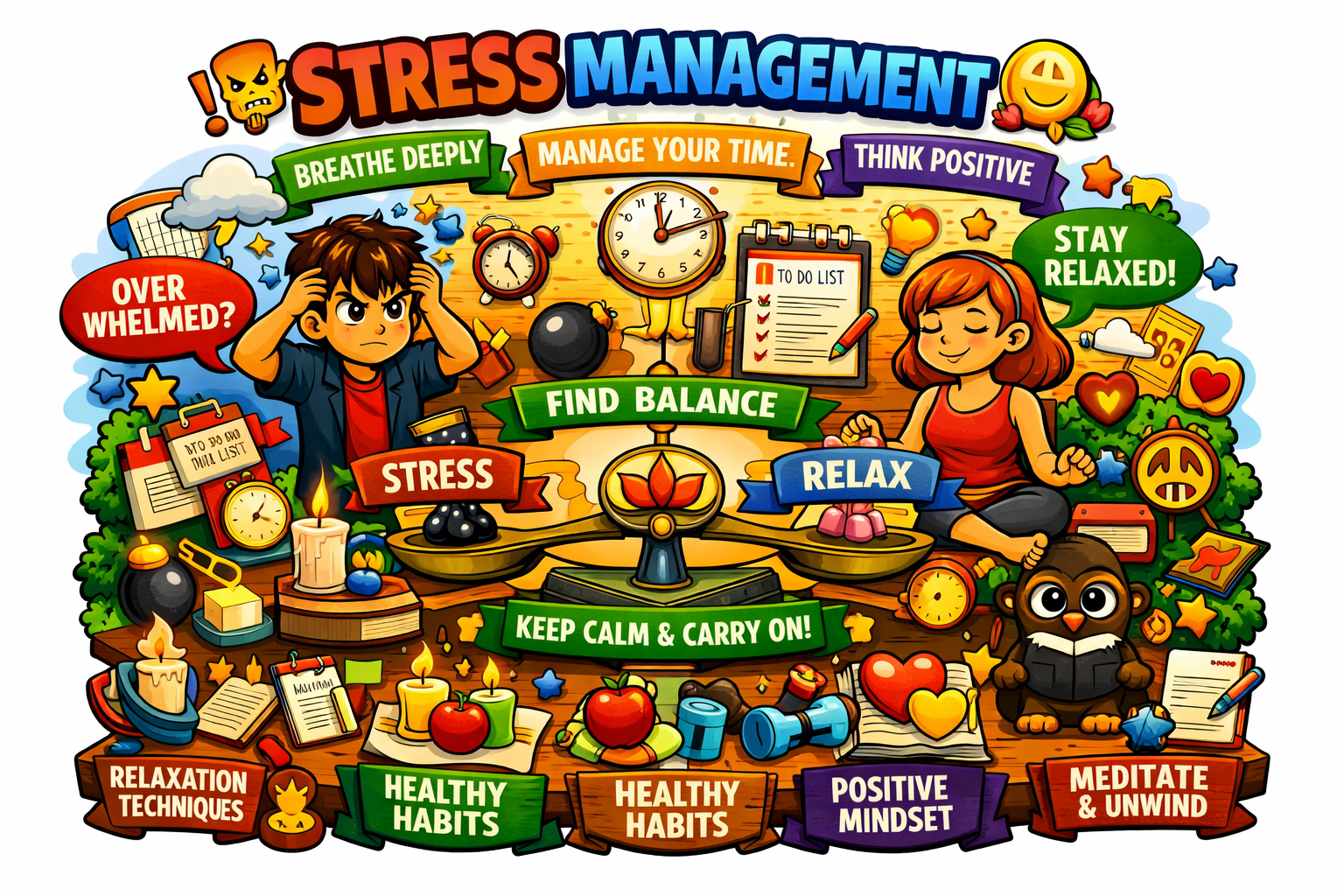
Practical Stress Management Techniques
| Technique | How to Use It | Why it Helps |
|---|---|---|
| Task Breakdown | Divide a big task into smaller steps. | Reduces overwhelm and creates progress. |
| Deep Breathing | Inhale slowly, hold briefly, and exhale slowly for a few rounds. | Calms the body and reduces immediate tension. |
| Time Blocking | Assign fixed time slots for study, work, breaks, and rest. | Improves focus and reduces last-minute pressure. |
| Positive Self-talk | Use realistic encouraging statements. | Reduces fear and builds confidence. |
| Physical Activity | Walk, stretch, exercise, or play a sport regularly. | Releases tension and improves mood. |
| Talking to Someone | Share concerns with a trusted friend, mentor, teacher, or family member. | Gives emotional support and practical perspective. |
| Digital Break | Take planned breaks from mobile, social media, and distractions. | Reduces mental overload and comparison stress. |
| Reflection | Write what caused stress and what can be done next. | Turns confusion into clear action. |
Note: A useful stress management method should be healthy, practical, and repeatable.
Step-by-Step Stress Control Process
Stress can be managed systematically by moving from emotional reaction to practical action.
| Step | Action | Example Question to Ask Yourself |
|---|---|---|
| 1. Notice | Recognise that you are feeling stressed. | What am I feeling right now? |
| 2. Pause | Take a short pause before reacting. | Can I breathe calmly for one minute? |
| 3. Identify | Find the actual cause of stress. | What exactly is causing this pressure? |
| 4. Separate | Separate what is controllable from what is not. | What part of this situation can I control? |
| 5. Plan | Choose one practical next step. | What is the smallest useful action I can take now? |
| 6. Act | Complete the first small step. | Can I start with 15 minutes of focused work? |
| 7. Recover | Rest, review, and continue with balance. | What will help me regain energy? |
Healthy and Unhealthy Coping Methods
| Unhealthy Coping | Why it is Harmful | Healthy Alternative |
|---|---|---|
| Procrastination | Increases pressure later. | Start with a small 10-minute task. |
| Overthinking | Creates fear without solving the issue. | Write the problem and one action step. |
| Anger or shouting | Damages relationships and creates more stress. | Pause, breathe, and speak calmly. |
| Skipping sleep | Reduces memory, mood, and performance. | Maintain a regular sleep routine. |
| Excessive screen use | Increases distraction and mental overload. | Take planned digital breaks. |
| Ignoring the problem | Allows the issue to become bigger. | Seek help or take one practical step. |
Note: Good coping methods reduce stress and improve long-term ability. Unhealthy coping gives temporary escape but increases problems later.
Practice
A) Multiple Choice Questions
-
Stress management means:
avoiding all responsibilities responding to pressure in a healthy way panicking in difficult situations ignoring all problems
-
Which is a healthy way to manage stress?
procrastinating deep breathing and planning shouting at others skipping sleep
-
What should you do first when you feel overwhelmed?
panic immediately pause and identify the cause avoid all tasks blame others
-
Which is an example of unhealthy coping?
planning tasks talking to a mentor overthinking without action taking a short walk
-
Time blocking helps reduce stress because it:
removes all work creates focused time for tasks increases confusion encourages delay
B) Situation-Based Practice
- You have an exam in three days and several chapters are pending. What should you do? (Hint: prioritise, plan, revise important topics first.)
- You are feeling stressed because of too many tasks. What is the first practical step? (Hint: write the tasks and arrange them by priority.)
- A friend criticises your work and you feel upset. How can you respond calmly? (Hint: ask for specific feedback.)
- You are unable to concentrate because of mobile distractions. What can you do? (Hint: use digital breaks and focused study slots.)
- You are overthinking a future problem. How can you reduce stress? (Hint: separate controllable and uncontrollable parts.)
C) Match the Stress Management Technique with Its Use
| Technique | Use |
|---|---|
| Deep breathing | Calms immediate physical tension |
| Task breakdown | Makes a large task easier to start |
| Time blocking | Creates focused time for important work |
| Positive self-talk | Reduces negative thinking and builds confidence |
| Talking to someone | Provides emotional support and perspective |
Well-being Reminder
Stress is a normal part of life, but unmanaged stress can affect learning, work, health, and relationships. A balanced person does not avoid challenges; instead, they plan, stay calm, take action, rest properly, and ask for support when needed. Stress management is therefore a practical skill for both personal growth and professional success.
Task: Write one current source of stress, one controllable action, and one healthy recovery habit.
Show Suggested Answers
Multiple Choice
- responding to pressure in a healthy way
- deep breathing and planning
- pause and identify the cause
- overthinking without action
- creates focused time for tasks
Situation-Based Practice: Sample Answers
- List the pending chapters, prioritise important topics, prepare a three-day revision plan, and revise in focused time blocks.
- Write all tasks on paper, mark urgent and important tasks, and begin with one small task.
- Say, “Thank you for the feedback. Can you tell me which specific part needs improvement?”
- Keep the phone away during study slots, turn off unnecessary notifications, and take planned digital breaks.
- Write down what is within your control, take one practical action, and let go of what cannot be controlled now.
Technique Matching
- Deep breathing → Calms immediate physical tension
- Task breakdown → Makes a large task easier to start
- Time blocking → Creates focused time for important work
- Positive self-talk → Reduces negative thinking and builds confidence
- Talking to someone → Provides emotional support and perspective
Clue Explanation
Effective stress management includes awareness, emotional control, planning, healthy habits, support systems, and practical action. It reduces panic and improves confidence, health, and performance.
Practical tips
- Do not ignore early signs of stress.
- Use a written plan instead of keeping everything in your mind.
- Focus on one task at a time.
- Maintain sleep, food, and exercise routines.
- Take short breaks during long work periods.
- Reduce unnecessary digital distractions.
- Seek support when stress feels difficult to handle alone.