Managerial Skills
Practice MCQsManagerial skills refer to the abilities and competencies that managers and leaders need to effectively perform their roles and responsibilities. These skills are essential for planning, organizing, leading, and controlling within an organization.
Managerial Skills are the abilities required to plan work, organise resources, guide people, solve problems, make decisions, and achieve goals effectively.
What are Managerial Skills?
Managerial skills help a person handle responsibilities, people, tasks, deadlines, and decisions in a systematic manner. These skills are useful not only for managers, but also for students, team leaders, entrepreneurs, project coordinators, and professionals.
A person with good managerial skills can understand a goal, divide the work, assign responsibilities, motivate people, monitor progress, solve problems, and complete tasks on time.
| Managerial Skill | Meaning | Example |
|---|---|---|
| Planning | Deciding what should be done and how. | Preparing a study timetable before exams. |
| Organising | Arranging people, resources, and tasks. | Dividing project work among team members. |
| Decision Making | Choosing the best option after considering facts. | Selecting the most practical solution to a problem. |
| Leadership | Guiding and motivating others towards a goal. | Encouraging a team to complete work on time. |
“Good management turns effort into organised results.”
Key points
- Set clear goals.
- Plan tasks before execution.
- Use time and resources wisely.
- Communicate expectations clearly.
- Make informed decisions.
- Monitor progress regularly.
- Solve problems calmly.
Major Types of Managerial Skills
Managerial skills can be grouped into different categories. A good manager uses all of them according to the situation.
Technical Skills
Knowledge of tools, methods, systems, or subject-specific work.
- Using software tools
- Understanding processes
- Preparing reports
- Handling data or documents
Human Skills
Ability to work with people effectively.
- Communication
- Teamwork
- Empathy
- Conflict handling
Conceptual Skills
Ability to understand the big picture and long-term impact.
- Strategic thinking
- Problem analysis
- Prioritisation
- Understanding cause and effect
Administrative Skills
Ability to organise work and maintain discipline.
- Scheduling
- Documentation
- Follow-up
- Resource allocation
Mini Managerial Skills Strategy Bank
Tip: A managerial person does not wait for confusion to become a crisis. They plan, monitor, and act early.
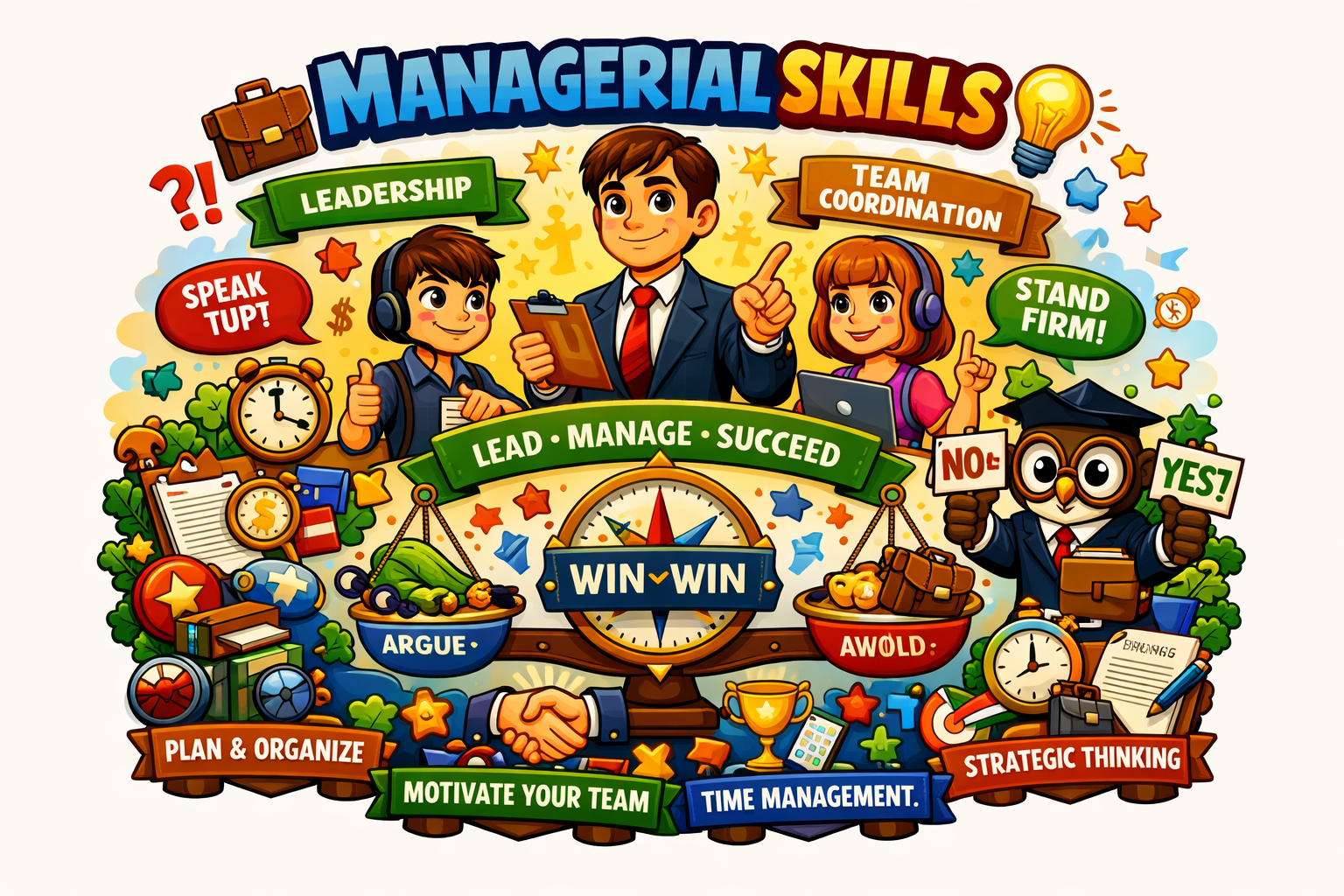
Core Managerial Skills and Their Practical Use
| Skill | What it Involves | Practical Example | Good Practice |
|---|---|---|---|
| Planning | Setting goals, steps, timelines, and resources. | Creating a weekly project plan. | Break large work into smaller tasks. |
| Organising | Arranging tasks, people, files, tools, and schedules. | Assigning roles for a college event. | Keep responsibilities clear and written. |
| Delegation | Assigning responsibility to suitable people. | Giving design work to a creative team member. | Delegate authority along with responsibility. |
| Decision Making | Choosing the best option after analysing facts. | Selecting the best vendor or solution. | Compare options, risks, cost, and benefit. |
| Problem Solving | Identifying root cause and finding workable solutions. | Resolving delay in project submission. | Focus on cause, not blame. |
| Communication | Explaining expectations, updates, feedback, and decisions clearly. | Conducting a team briefing. | Confirm understanding after giving instructions. |
| Motivation | Encouraging people to perform with interest and responsibility. | Appreciating team members for good work. | Recognise effort and guide improvement. |
| Control and Review | Monitoring performance and correcting deviations. | Checking weekly progress against targets. | Review early, not only at the end. |
Note: Managerial skills work together. Planning without review may fail, and delegation without communication may create confusion.
The Management Process
Most managerial activities follow a simple cycle: plan, organise, lead, monitor, and improve.
| Step | Action | Question to Ask |
|---|---|---|
| 1. Plan | Decide goal, timeline, resources, and method. | What exactly needs to be achieved? |
| 2. Organise | Arrange people, materials, information, and tasks. | Who will do what? |
| 3. Lead | Guide, motivate, communicate, and support people. | How do we keep the team aligned? |
| 4. Monitor | Track progress and compare with the plan. | Are we moving as expected? |
| 5. Improve | Correct problems and learn from results. | What can be done better next time? |
Common Managerial Mistakes and Better Approaches
| Common Mistake | Impact | Better Approach |
|---|---|---|
| Starting work without a plan | Confusion, delay, and repeated corrections. | Prepare a simple action plan before execution. |
| Doing everything alone | Overload and poor team involvement. | Delegate suitable tasks to suitable people. |
| Unclear instructions | Wrong output or repeated questions. | Explain expected result, deadline, and quality standard. |
| No follow-up | Problems are noticed too late. | Use periodic progress checks. |
| Blaming instead of solving | Fear, conflict, and low morale. | Discuss causes and corrective action. |
| Ignoring feedback | Repeated mistakes and missed improvement. | Collect feedback and improve the process. |
Note: Managerial maturity is shown by calm thinking, clear communication, and timely corrective action.
Practice
A) Multiple Choice Questions
-
Managerial skills are mainly used to:
avoid responsibility plan, organise and achieve goals create confusion do only personal work
-
Which skill helps in assigning work to suitable people?
delegation guessing complaining avoiding
-
What should a manager do before making an important decision?
ignore facts compare options and consequences decide emotionally blame others
-
Which is an example of human skill?
team communication machine speed file size office furniture
-
Monitoring means:
forgetting the task checking progress regularly starting without planning avoiding feedback
B) Situation-Based Practice
- Your team has a project deadline in five days. What managerial steps will you take? (Hint: plan, divide work, set timeline, monitor progress.)
- Two team members are arguing about how to complete a task. What should you do? (Hint: listen, identify issue, focus on solution.)
- A team member is skilled but not completing work on time. How will you handle it? (Hint: understand reason, clarify expectations, follow up.)
- You have too many tasks and limited time. What should you do first? (Hint: prioritise urgent and important tasks.)
- A completed task has many errors. How should you respond managerially? (Hint: review errors, find cause, guide correction.)
C) Match the Managerial Skill with the Example
| Example | Managerial Skill |
|---|---|
| Preparing a task schedule before starting a project. | Planning |
| Assigning report writing to the person who writes well. | Delegation |
| Choosing the best option after comparing cost and benefit. | Decision making |
| Checking whether work is completed as per timeline. | Monitoring |
| Encouraging the team after a difficult phase. | Motivation / Leadership |
Managerial Reminder
Managerial skills are useful in every area of life. A student uses managerial skills while preparing for exams, a team leader uses them while completing a project, and an entrepreneur uses them while running a business. The foundation of good management is clarity, responsibility, communication, discipline, and continuous improvement.
Task: Choose one activity from your life and prepare a simple management plan using goals, tasks, deadline, resources, and review points.
Show Suggested Answers
Multiple Choice
- plan, organise and achieve goals
- delegation
- compare options and consequences
- team communication
- checking progress regularly
Situation-Based Practice: Sample Answers
- Prepare a task list, assign responsibilities, set daily targets, and review progress every day.
- Listen to both sides, identify the actual issue, and guide them towards a practical solution.
- Discuss the delay, understand the reason, clarify deadline expectations, and follow up regularly.
- List all tasks and complete the urgent and important tasks first.
- Review the errors, identify why they occurred, correct the work, and improve the process.
Skill Matching
- Task schedule → Planning
- Assigning work to suitable person → Delegation
- Comparing cost and benefit → Decision making
- Checking timeline → Monitoring
- Encouraging team → Motivation / Leadership
Clue Explanation
Managerial skills combine planning, organising, communication, leadership, decision making, problem solving, delegation, and review. A strong manager focuses on both people and results.
Practical tips
- Start every major task with a clear goal.
- Write down responsibilities and deadlines.
- Communicate expectations clearly.
- Delegate based on ability and availability.
- Review progress before the deadline.
- Use feedback to improve future performance.
- Balance task completion with team morale.